
SIntroduction
Here’s a question most first-time visitors to Hawaii don’t think to ask until they’re already booking: “What will the weather actually be like?”
They assume tropical means hot and sunny. And they’re right — mostly.
But Hawaii’s weather is far more nuanced, far more variable, and honestly far more interesting than the postcard version suggests. Hawaii weather is about as sporadic as it gets — forecasting it can be both daunting and confusing to visitors. This isn’t the mainland, and the climate takes some getting used to.
Weather conditions can change dramatically within Hawaii and on each island due to diverse topography, changes in elevation, the trade winds, and other unique island conditions. You can be driving along and pass through three completely different weather patterns in twenty minutes. Rain on one side of a mountain. Bright sunshine on the other. Mist in the valley below.
The good news? The weather in Hawaii is consistently pleasant throughout the year, oscillating between mild and hot temperatures — which means you’ll likely enjoy some fantastic weather and spells of sunshine whenever you visit.
This guide cuts through the confusion. Whether you’re planning your first trip to Oahu, comparing islands, or trying to figure out the best month for your vacation — you’ll leave this page knowing exactly what to expect.
Understanding Hawaii’s Climate — The Basics
Tropical Climate with a Twist
Hawaii sits in the tropics, roughly 20 degrees north of the equator. That placement gives it the warm, humid, sunshine-rich climate the islands are famous for. Sea-level temperatures are remarkably consistent — average daytime highs are near 85°F in summer and 78°F in winter, usually falling 10–15 degrees overnight.
But calling Hawaii simply “tropical” undersells the complexity of what’s happening here. The islands were built by volcanic activity, and their dramatic topography — soaring peaks, deep valleys, coastal plains — creates an enormous range of microclimates crammed into very small geographic areas.
The Big Island alone features 11 of the 13 recognized climate zones on Earth — from lush tropical rainforest on the windward east side to near-desert conditions on the leeward west coast, and alpine tundra near the summits of Mauna Kea and Mauna Loa.
Windward vs. Leeward — The Most Important Thing to Know

If there’s one concept that unlocks your understanding of Hawaii’s weather, it’s the difference between windward and leeward coasts.
- Windward (north and east-facing coasts): Face into the northeast trade winds. These winds bring moisture from the ocean, which hits the mountains, rises, cools, and falls as rain. Windward coasts are lusher, greener, and significantly wetter.
- Leeward (south and west-facing coasts): Sheltered from the trade winds. The air that passes over the mountains loses its moisture on the windward side, arriving on the leeward side as dry, warm air. Leeward coasts are sunnier, drier, and home to most of Hawaii’s famous beach resorts.
The north and east coasts tend to experience more rainfall, while the south and west coasts are generally drier.
This one fact explains more about Hawaii’s weather than anything else. When you’re choosing where to stay on any Hawaiian island, windward vs. leeward matters far more than the time of year.
Hawaii’s Two Seasons: Dry and Wet
Hawaii has two distinct seasons: the dry season, from April to September, with minimal rainfall, and the wet season, from November to March. Hawaii generally describes May–October as summer and November–April as winter. Winter brings more variable weather, but even wetter regions can enjoy long spells of sunshine.
Don’t let “wet season” scare you off. Showers are frequent during the wet season, but often brief, followed by a ray of sunshine and perhaps a rainbow or two — the state is even known as the rainbow capital of the world!
The Role of Trade Winds
The northeast trade winds are Hawaii’s natural air conditioning system. They blow across the islands the majority of the year, keeping humidity manageable and temperatures comfortable — especially on leeward coasts.
The trade winds, Hawaii’s most important weather feature, blow from the northeast most days, keeping conditions comfortable on leeward (western) coasts while bringing more clouds and showers to windward (eastern) sides.
When the trade winds stop — which occasionally happens — temperatures rise, humidity spikes, and what’s called “Kona weather” sets in. During trade wind interruptions in summer, leeward areas can feel noticeably hotter and more muggy than usual.
Hawaii Weather by Month — Month-by-Month Breakdown
Keep in mind that each island will vary slightly in both temperature and weather — but here’s generally what you can expect in terms of weather and tourist activities each month in Hawaii.
January & February
it in the heart of Hawaii’s wet season. January has an average high of 81°F and an average low of 64°F, with around three inches of precipitation over the month. February has an average high of 81°F and an average low of 66°F with 3.5 inches of precipitation — one of the rainier months of the year, and also popular among travelers looking to flee gloomy, cold weather on the mainland.
What to expect:
- Mild beach temperatures with occasional cloudy periods
- North shore surf peaks — ideal for watching big wave surfing
- Humpback whale watching season is in full swing (January through March)
- Higher hotel rates and crowds, especially around New Year’s and Presidents’ Day
Best for: Whale watching, big wave surfing (as a spectator), escaping mainland winters
March & April
If you’re looking for days filled with sunshine and nights with ocean breezes, March is a lovely time for a visit to Hawaii. Daytime temperatures hover between the upper 70s and low 80s with plenty of sunshine and blue skies — though a light sweater is worth packing because temperatures can dip into the low 60s during evenings. By April, rainfall levels abate, leaving behind lush green surroundings and full waterfalls. Dry weather conditions and quieter surroundings make April, May, and June a lovely period to visit Hawaii.
What to expect:
- March: Last of the whale season, Spring Break crowds, occasional rainy days
- April: Green landscapes from winter rains, improving weather, thinning crowds
- Ocean transitions from winter to spring conditions
Best for: Budget travelers, hikers, photography enthusiasts
May & June
May marks the beginning of Hawaii’s dry season — and one of the best-kept secrets among experienced Hawaii travelers.
June is the driest time of the year with the least rainfall. With the summer crowds yet to arrive in full force, you can make the most of the scorching climate in a more peaceful setting, reaching temperatures of up to 28°C (82°F) on average.
What to expect:
- Increasingly sunny and dry conditions across all islands
- Trade winds at their most reliable — comfortable beach temperatures
- June: Start of summer crowds, but still manageable in early month
- Ocean water warming toward summer peak temperatures
Best for: First-timers, families, anyone who wants great weather without the peak summer prices and crowds
July & August
Peak summer. crowds. heat.
July is a sunny month with an average temperature of 29°C (84°F). August brings the year’s highest temperatures — while hurricanes are uncommon in Hawaii, the risk is slightly higher in late summer. Daytime highs may hit 90°F, with lows around 74°F, and water temperatures reach 80°F. Hawaii’s weather in August is characterized by warm, sunny days, with average temperatures reaching up to 30°C (86°F) and little chance of rain — unless you’re traveling to Kauai.
What to expect:
- Hottest and driest weather of the year
- Highest hotel prices and fullest beaches
- South shore surf (opposite of winter)
- August: Statistically the most active month for Pacific hurricanes
Best for: Summer family travel, beach lovers, water sports
September & October
September is the best month to visit Hawaii. October is a close second. Here’s why: summer’s heat stays, the summer crowds leave, and the wet season hasn’t arrived yet. The crowds leave but dry weather conditions continue, making September another great month to visit Hawaii. The water is at its warmest and clearest during this month — perfect for exploring Hawaii’s colorful underwater world. Daytime highs are still in the 80s, and the water is warm. These factors coupled with thinning crowds make October a great time to visit the islands.
What to expect:
- September: Summer weather, post-summer crowds, excellent value
- October: Transitional month — still mostly dry, occasional early wet season showers
- The average high temperature in October is 88°F, with the average low being 73°F — but rainfall on the islands picks up, with an average of nearly 3.25 inches of rain throughout the month.
Best for: Value seekers, snorkelers and divers (clearest water), couples, honeymooners
November & December
November is one of the rainiest months on the islands — rains total nearly 5 inches on average. The average high temperature in November is 84°F and the average low is 72°F. As a result, November is one of the best times to visit the islands if you want to avoid the crowds and take advantage of cheaper hotel rates — just be sure to pack a raincoat.
December closes out the year with a return to peak travel demand. Holiday visitors and winter escape travelers flood the islands. North shore surf season returns, and humpback whales begin appearing off the coasts again.
What to expect:
- November: Wet season onset, fewer tourists, best prices
- December: Holiday surge in visitors and prices, increasing rain, returning whale season
- North shore swells building to winter heights
Best for: Budget travelers willing to trade some sunshine for savings (November); holiday atmosphere (December)
Hawaii Weather by Island — What to Expect on Each Island
One of the most important truths about Hawaii’s weather: no two islands are the same.
The best thing about Hawaii’s weather is that it is very localized — you may be driving along the island and be in a rainstorm one minute and in bright sun the next. This variety of weather allows you to fully experience Hawaii and its sun-drenched beaches, misty rainbow-filled valleys, pristine waterfalls, cool highlands, and lush mountains.
Oahu Weather
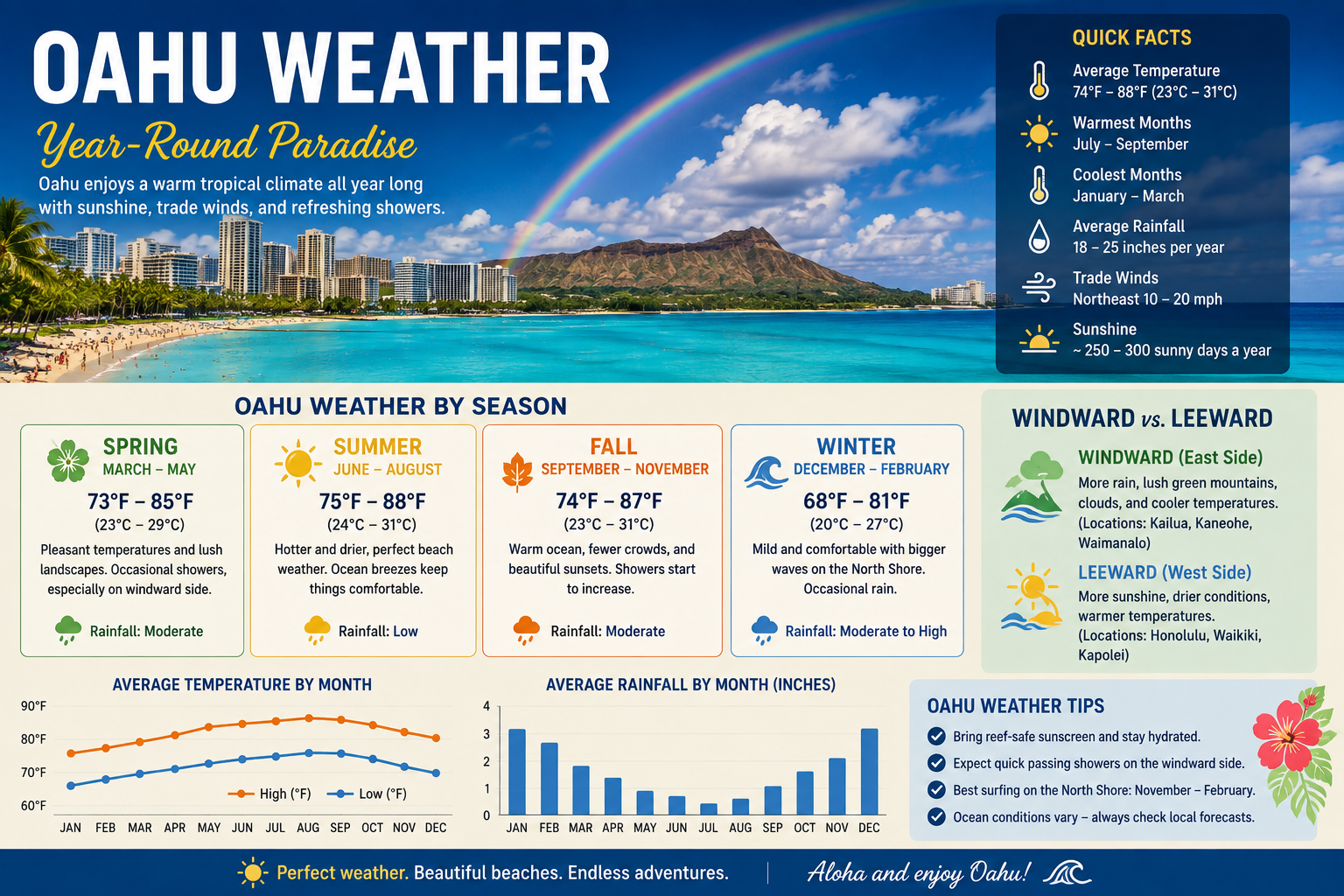
Oahu has the driest climate of the Hawaiian Islands. Bad weather is rare. Temperatures around Honolulu and Waikiki typically range between 81–91°F, and showers are usually brief and light.
The south shore — including Waikiki, Honolulu, and Ko Olina — is sheltered from trade wind rain and is one of the sunniest stretches of coastline in all of Hawaii. The southern side of Oahu, including Waikiki and Honolulu along with the southwest coast at Ko Olina, are your best bet for lots of Hawaiian sunshine.
The North Shore is a different story — it receives more rainfall year-round and hosts the world’s most famous big wave surf breaks in winter.
Summer highs: 85–91°F | Winter highs: 78–82°F | Best area for sunshine: South/West Oahu (Waikiki, Ko Olina)
Maui Weather
Maui offers ideal weather conditions. Highs range from 82–89°F and lows from 63–71°F. The South Shore — Kihei, Wailea, Kahului, and Makena — is known for sunnier and drier conditions. Choose the sunny South Coast near Wailea for nearly guaranteed sunshine all year round. While Lahaina, Kaanapali, and Kapalua in West Maui get a bit more rain compared to South Maui, the overall area has relatively low rain levels and good amounts of beautiful Hawaiian sun. The windward east side of Maui, including beautiful Hana, tends to have more rain, which creates those beautiful waterfalls and rainforests.
High-elevation Haleakalā adds another dimension. If you plan to venture to the top of Maui’s inactive volcano, Haleakalā, plan to bring a warm, windproof jacket, hat, and gloves — it can get cold, especially overnight.
Summer highs: 85–89°F | Winter highs: 78–83°F | Best area for sunshine: South Maui (Wailea, Kihei)
Kauai Weather
Kauai, the Garden Isle, has lush landscapes and varied rainfall. While it has a reputation for being the wettest island, it actually has a mix of dry spells and quick showers — with rainfall higher on the north shore compared to the south coast. The south shore and east coast tend to be drier, while the north shore is wetter. Daytime highs on the Garden Isle are generally in the upper 70s to mid-80s°F near the coast, with cooler nights.
The contrast is striking: Kauai’s north shore (Na Pali Coast, Hanalei) is one of the wettest and most lush landscapes in the world. Yet Poipu Beach on the south shore enjoys some of the most consistent sunshine in Hawaii. Same island; completely different weather.
Fun fact: Kauai’s Wai’ale’ale is one of the world’s wettest places, with annual rainfall measured in the hundreds of inches.
Summer highs: 82–86°F | Winter highs: 76–80°F | Best area for sunshine: South Kauai (Poipu Beach area)
Big Island (Hawaii Island) Weather
The Big Island is in a weather category of its own. The Big Island features 11 of the 13 recognized climate zones on Earth — more climate diversity than almost any other place on the planet of comparable size.
Average temperatures near the major resort areas (coastline) range from 75–85°F in winter and summer, respectively. At higher elevations like Volcano and Waimea, temperatures are often much cooler, especially during the night.
Two cities. Two completely different worlds:
- Hilo is rainy, with temperatures between 81–85°F and lows from 66–81°F.
- Kailua-Kona stays warmer year-round, with highs from 84–89°F and lows from 68–76°F.
The Kohala (Gold) Coast is almost always sunny year-round and offers the best chance for dry weather, averaging just 0–10 inches annually.
Summer highs (Kona coast): 84–89°F | Winter highs (Kona coast): 78–84°F | Best area for sunshine: Kohala Coast, Kailua-Kona
Hawaii Temperature Guide
Average Temperatures by Season
| Season | Average High | Average Low | Ocean Temp |
|---|---|---|---|
| Summer (May–Oct) | 85–90°F (29–32°C) | 70–75°F (21–24°C) | 78–80°F (25–27°C) |
| Winter (Nov–Apr) | 78–83°F (25–28°C) | 63–70°F (17–21°C) | 74–76°F (23–24°C) |
Ocean Water Temperatures
Ocean temperatures range from 75–80°F year-round, making Hawaii tropical all year and ideal for swimming, snorkeling, and diving in every season.
Mountain Elevations & Snow in Hawaii
Yes — it snows in Hawaii. Just not where you’re staying.
The tall volcanic mountains of Hawaii are significantly colder than beach elevations. With elevations over 13,000 feet above sea level, it’s not unusual for Mauna Kea and Mauna Loa on the Big Island to get snow in the winter. At an elevation over 10,000 feet above sea level, Haleakalā on Maui can also get snow. Elevation can make mountain areas much cooler — Mauna Kea’s summit can be below freezing even when Kona beaches are 85°F. If you’re planning a summit visit, pack winter layers regardless of what month you visit.
Hawaii Rainfall Guide
Which Islands Get the Most Rain?
From wettest to driest overall:
- Kauai — Heaviest rainfall, especially north/interior
- Big Island (windward side) — Hilo is one of the rainiest cities in the US
- Maui — Varied; south shore dry, east side very wet
- Oahu — Driest of the main islands overall
Wettest vs. Driest Areas on Each Island
| Island | Driest Area | Wettest Area |
|---|---|---|
| Oahu | Waikiki / Ko Olina (south) | North Shore / Ko’olau Mountains |
| Maui | Wailea / Kihei (south) | Hana (east) / Big Bog |
| Kauai | Poipu (south) | Wai’ale’ale / North Shore |
| Big Island | Kohala Coast (west) | Hilo / windward slopes |
Notable rainfall facts:
- Big Bog on Maui is alleged to be one of the wettest places on Earth, with a reported annual rainfall of 404 inches for the period 1992–2018, according to the University of Hawaiʻi at Mānoa.
- While the summit of Mount Wai’ale’ale on Kauai has long been considered the wettest place in the Hawaiian Islands and was claimed to be the second wettest place on Earth, its NOAA-reported annual rainfall of 373.85 inches is exceeded by Big Bog’s 30-year average.
When Does It Rain in Hawaii?
Rain usually comes as brief afternoon showers that clear within an hour. You’ll still get plenty of sunshine even in the wettest months.
The exception is kona storm systems, which can bring prolonged, heavy rainfall. Called a kona low, these storms typically occur in the winter months — arriving as wind blows in from the westerly leeward direction, or the “kona,” which is the opposite of the normal route of the trade winds.
When a kona low hits, it can be dramatic. A recent Hawaii storm dumped up to 46 inches of rain and broke decades-old records — the island of Maui saw the heaviest rainfall, with multiple areas reporting over 20 inches of rain and one location logging as much as 46 inches of precipitation.
These events are relatively rare, but they underscore why travel insurance is worth considering for winter Hawaii trips.
Hawaii Trade Winds — What Are They and Why Do They Matter?
The northeast trade winds are the engine behind Hawaii’s pleasant, livable climate. They blow reliably across the islands from the northeast, typically at 10–20 mph, most days of the year.
Here’s what they do:
- Cool the islands naturally — without trade winds, Hawaii would be significantly hotter and more humid
- Create the windward/leeward weather divide — the single biggest factor in regional weather variation
- Drive rainfall patterns — moisture-laden trade winds hit volcanic peaks and drop rain on windward slopes
- Make leeward coasts comfortable — warm, dry breezes on the leeward side create ideal beach conditions
When trade winds stall — a periodic occurrence in summer — the result is called vog (volcanic fog) on the Big Island, where volcanic emissions from Kilauea spread across more of the island. Vog can cause respiratory irritation and reduce visibility. It’s worth checking the vog forecast if you have respiratory sensitivities and are visiting the Big Island.
Hurricane Season in Hawaii
When Is Hurricane Season?
The Pacific hurricane season lasts from June through November. Hurricanes are rare in Hawaii, but if one does strike, it is most likely in July, August, and September.
How Likely Is a Hurricane to Hit Hawaii?
Statistically, a direct hurricane strike on Hawaii is quite rare. The islands are located in an area where most tropical systems either track south of the archipelago or weaken as they approach from warmer waters to the east.
That said, while hurricanes are uncommon in Hawaii, the risk is slightly higher in late summer. Tropical storms can still bring heavy rain, elevated surf, and gusty winds even when they don’t make direct landfall — as Tropical Storm Moke demonstrated recently, moving northwest toward Hawaii and bringing passing showers and strong winds to Maui, with the Big Island taking the worst of it — heavy rain especially on windward and southeast slopes.
Smart traveler tips for hurricane season:
- Purchase travel insurance that covers weather disruptions if traveling June–November
- Monitor the National Hurricane Center (nhc.noaa.gov) during late summer visits
- Have a flexible itinerary that allows for indoor activities if weather turns
El Niño & La Niña Effects on Hawaii Weather (2026 Update)
Hawaii’s weather doesn’t happen in isolation — it’s influenced by large-scale Pacific climate patterns, particularly El Niño and La Niña.
The 2026 situation is significant:
NOAA gives a greater than 90% chance of a very strong El Niño in fall and winter 2026–27. Plan for a drier wet season, weaker trades, and winter surf. For October–December, NOAA’s strength table puts the chance of a very strong event at 95%, including a 69% chance the three-month Relative Oceanic Niño Index reaches at least +2.5°C — a historic level that would exceed previous events in NOAA’s record dating to 1950.
What El Niño typically means for Hawaii:
- Drier wet season — Less rain November through March than a typical La Niña year
- Weaker trade winds — More variable weather patterns
- Warmer sea surface temperatures — Can affect marine ecosystems
- More active central Pacific hurricane season in some El Niño years
One important caveat: a seasonal forecast is a tilt in the odds, not a daily weather report. Stronger events make typical El Niño effects more likely, but they do not guarantee a particular outcome in Hawaiʻi.
Practical implication for 2026–27 travelers: If you’re planning a November–March Hawaii trip, the El Niño forecast actually favors better than average winter weather — a drier wet season means more sun during what would typically be Hawaii’s rainiest months.
Best Time to Visit Hawaii for Weather
Best Months for Sun & Low Rain
In order of most reliably dry and sunny:
| Rank | Month | Why |
|---|---|---|
| 1 | June | Driest month of the year, fewest rain days |
| 2 | July | Warm, sunny, peak summer conditions |
| 3 | August | Hottest and sunniest — peak summer |
| 4 | September | Summer conditions, post-crowd calm |
| 5 | May | Shoulder season, improving weather |
| 6 | October | Still mostly dry, crowds thinning |
Best Months to Avoid Crowds AND Get Good Weather
The best time to visit Hawaii is during the shoulder season months: April, May, September, October, and November (before Thanksgiving). During these periods, you will find good weather, fewer crowds, and the best prices.
Our top picks by traveler type:
| Traveler Type | Best Month | Why |
|---|---|---|
| Honeymoon / Romance | September | Warm water, post-crowd calm, golden light |
| Families | May or June | School still in session (pre-summer), good weather |
| Budget Travelers | May or November | Lower rates, decent weather |
| Whale Watchers | January–March | Peak humpback season |
| Big Wave Surfing Fans | November–February | North shore swell season |
| Snorkeling & Diving | August–October | Warmest, clearest water |
| Hikers | April–May | Lush post-rain landscapes, cooler temps |
Best Time to Visit Each Island
| Island | Best Weather Month | Notes |
|---|---|---|
| Oahu | April–October | Reliable sunshine year-round; driest island overall |
| Maui | April, May, September | South shore stays dry nearly year-round |
| Kauai | June–September | Most reliable sunshine on south shore; north shore remains wet |
| Big Island | Year-round (Kona side) | Kohala Coast almost always sunny regardless of season |
What to Pack Based on Hawaii’s Weather
Hawaii’s weather is warm, but it’s not one-dimensional. Here’s what to pack regardless of which month you visit:
Essential for everyone:
- High-SPF reef-safe sunscreen (required in Hawaii — chemical sunscreens that harm coral reefs are banned)
- Hat and UV-protective sunglasses
- Swimwear (multiple pieces — things stay damp in humid air)
- A lightweight, packable rain jacket — brief showers can happen any time, anywhere
- Comfortable walking sandals and reef-safe water shoes for snorkeling
- Mosquito repellent (especially for jungle hikes and east-side areas)
Add for winter trips (November–March):
- A light cardigan or hoodie for evenings (temperatures can dip to the low 60s)
- A sturdier rain jacket — kona storms can bring sustained rain
Add for mountain or volcano visits (any time of year):
- Warm layers — summit temperatures can be near freezing even on hot beach days
- Hiking boots for volcanic terrain
Frequently Asked Questions
Q: What is the weather like in Hawaii year-round? A: Hawaii has a tropical climate with warm, pleasant weather every month of the year. Average daytime highs sit near 85°F in summer and 78°F in winter. The two seasons are a dry season (May–October) and a wet season (November–April). Even in the wet season, rain is typically brief and followed by sunshine.
Q: Which month has the best weather in Hawaii? A: June through September offers the most reliably dry and sunny weather across all islands. For the best combination of great weather, smaller crowds, and lower prices, September and October are hard to beat.
Q: Does it rain every day in Hawaii? A: Not on the leeward (south and west) coasts. Rain in Hawaii is typically brief and localized — a sudden shower that clears within an hour. Rain usually comes as brief afternoon showers that clear within an hour — you’ll still get plenty of sunshine even in the wettest months.
Q: Which Hawaiian island has the best weather? A: Oahu has the driest climate of the Hawaiian Islands overall. For the sunniest specific location in Hawaii, the Kohala Coast on the Big Island averages almost no rainfall year-round. Maui’s south shore (Wailea/Kihei) is also a remarkably consistent sunshine destination.
Q: Does it snow in Hawaii? A: Yes — but only at extreme elevations. With elevations over 13,000 feet above sea level, it’s not unusual for Mauna Kea and Mauna Loa on the Big Island to get snow in winter. At an elevation over 10,000 feet, Haleakalā on Maui can also see snow. Beach areas never see snow.
Q: When is hurricane season in Hawaii? A: The Pacific hurricane season lasts from June through November. Hurricanes are rare in Hawaii, but if one does occur, it is most likely in July, August, and September.
Conclusion
Hawaii’s weather is one of its greatest gifts — and one of its most misunderstood features.
It’s not just “always sunny and warm,” though it often is. It’s a living, breathing mosaic of microclimates shaped by ocean, mountains, trade winds, and volcanic geology. The weather is diverse here because the topography is also diverse. That diversity is part of what makes Hawaii so extraordinary — you can stand in a desert and be 30 minutes from a rainforest. You can surf on a sunny beach while clouds drape the mountain above you.
The key takeaways:
- Windward vs. leeward matters more than the time of year — choose the right side of the island and you’ll have great weather almost any month
- Dry season (May–October) is most reliable for sunshine, but shoulder months (April–May, September–October) offer the best overall value
- Every island is different — Oahu’s Waikiki and the Big Island’s Kohala Coast are two of the most consistently sunny places in Hawaii, year-round
- Rain doesn’t mean a ruined trip — brief tropical showers are part of Hawaii’s charm, and they clear fast
This variety of weather allows you to fully experience Hawaii and its sun-drenched beaches, misty rainbow-filled valleys, pristine waterfalls, cool highlands, and lush mountains.
The islands are waiting — in any weather, they’re extraordinary.