Table of Contents
- Step 1 — Choose Your Island
- Step 2 — Decide When to Go
- Step 3 — Set Your Hawaii Budget
- Step 4 — Book Your Flights
- Step 5 — Choose Your Accommodation
- Step 6 — Plan Your Transportation
- Step 7 — Build Your Hawaii Itinerary
- Step 8 — Understand Hawaii’s Food Scene
- Step 9 — Pack for Hawaii
- Step 10 — Know the Safety Rules
- Hawaii Travel Tips — Insider Knowledge
- Hawaii Practical Information
- Your Complete Hawaii Planning Resource Library
- Frequently Asked Questions
- Final Thoughts
Introduction
Planning a trip to Hawaii is one of the best things you will ever do for yourself.
It is also — if you’ve never done it before — one of the more complex travel planning challenges in the American travel landscape. Hawaii isn’t just one destination. It’s eight islands spread across 1,500 miles of Pacific Ocean, each with its own distinct character, logistics, weather patterns, and pricing. It requires actual flights, actual rental cars, actual advance reservations — and a real understanding of what you’re walking into if you want to get it right.
This guide is designed to take you from “I want to go to Hawaii” to “I am completely ready to go to Hawaii” in a single read.
We’ll walk through every step of the planning process: choosing the right island, picking the best time to visit, setting a realistic budget, booking flights and accommodation, packing correctly, staying safe, and arriving on the islands as a respectful, prepared, and genuinely excited traveler.
No fluff. No filler. Just everything you actually need to know.
Let’s plan your trip.
Step 1 — Choose Your Island
This is the single most important decision in Hawaii trip planning — and the one most first-timers skip over by defaulting to whatever their travel agent or airline suggests.
The right island for you depends entirely on what kind of traveler you are. For a full island-by-island comparison, read our Complete Hawaiian Islands Guide →. Here is the quick version:
Quick Island Personality Guide
| Island | Best For | Vibe | Crowds |
|---|---|---|---|
| Oahu | First-timers, families, history, culture | Urban + Beach | High |
| Maui | Couples, honeymooners, beaches, luxury | Romantic + Adventure | High |
| Big Island | Nature lovers, hikers, stargazers, budget | Wild + Diverse | Moderate |
| Kauai | Photographers, hikers, repeat visitors, off-grid seekers | Remote + Stunning | Low-Moderate |
| Molokai | Authentic Hawaii seekers, responsible travelers | Local + Uncommercial | Very Low |
| Lanai | Ultra-luxury travelers, seclusion | Exclusive + Rugged | Very Low |
The honest shortcut:
- First Hawaii trip → Oahu or Maui
- Already been? → Big Island or Kauai
- Want absolute seclusion? → Lanai or Molokai
How Many Islands Should You Visit?
This question trips up more Hawaii planners than any other. The temptation to see as much as possible in a single trip is understandable — but it almost always backfires.
The golden rule: spend at least 5 full days on each island you visit. Any less, and you’re essentially just seeing the surface.
- 7–9 days: Stay on one island. Go deep, not wide.
- 10–12 days: Consider two islands — one main, one neighbor.
- 14+ days: Two to three islands is realistic with careful planning.
Where to Go If You Only Have One Week
- Oahu — the most content per square mile. You will not run out of things to do.
- Maui — the most beautiful single-island experience. Beach plus volcano plus rainforest, all in one week.
- Big Island — the most diverse and least expensive. Ideal for nature-focused travelers.
One week is not enough for Kauai plus anything else — it’s a slow island that rewards time. If Kauai is your dream, go for 7 days and nothing else.
Step 2 — Decide When to Go
Hawaii is a year-round destination. There is no “bad” time to visit — but there are better times and worse times depending on your priorities.
Best Time to Visit Hawaii by Travel Style
| Travel Style | Best Months | Why |
|---|---|---|
| Best weather + fewer crowds | April–May | Post-spring break, pre-summer, perfect temperatures |
| Best value | September–October | Summer crowds gone, prices drop, weather excellent |
| Whale watching | December–March | Humpback season — best in February |
| Big surf (North Shore) | November–February | Eddie Aikau invitational season |
| Family travel | June–August | Kids are out of school — book WAY ahead |
| Snorkeling & diving | May–September | Calmer water conditions on most islands |
| Avoiding rain | May–September | Driest months across most islands |
Hawaii Peak vs. Shoulder vs. Off-Season
Peak Season (June–August, December–January): The highest prices, most crowds, and busiest beaches. Summer brings families; winter brings holiday escape seekers. Hotel rates can be 30–50% higher than shoulder season. Book 4–6 months in advance minimum.
Shoulder Season (April–May, September–November): This is the sweet spot. Weather is excellent — warm, dry, and predictable on south and west shores. Crowds thin noticeably. Hotels drop prices. Activities are easier to book. These months are consistently the best overall value in Hawaii travel.
Rainy Season (October–April, primarily north shores): Hawaii’s “rainy season” is highly localized. South and west shores remain sunny even during wetter months. North shores and windward sides (particularly Oahu’s Ko’olau Mountains and Kauai’s north shore) receive the most rainfall. Flash flooding risk is highest October through April.
Month-by-Month Quick Planner
| Month | Weather | Crowds | Cost | Special Notes |
|---|---|---|---|---|
| January | Warm, some rain | High | High | Peak winter escape; whale season begins |
| February | Warm, occasional rain | High | High | Best whale watching month |
| March | Warming | Moderate-High | Moderate-High | Spring break surge last 2 weeks |
| April | Excellent | Low-Moderate | Moderate | Best overall month to visit |
| May | Near perfect | Low | Moderate | Hidden gem — excellent weather, low prices |
| June | Hot, sunny | Rising | Moderate-High | School’s out; families arriving |
| July | Hot, sunny | Highest | Highest | Book everything 4–6 months ahead |
| August | Hot, sunny | High | High | Hurricane season begins |
| September | Excellent | Low | Lower | Best value month of the year |
| October | Warm, some rain | Moderate | Lower | Kona storm season begins |
| November | Warm | Moderate | Moderate | Thanksgiving week surges |
| December | Warm, some rain | Very High | Highest | Holiday peak; book 6+ months ahead |
Hawaii Weather Risks to Know Before You Book
Hawaii has genuine weather risks that every traveler must understand:
- Flash flooding — most common October through April, particularly on Oahu’s North Shore and windward valleys. The March 2026 floods were the worst in 20 years, with hundreds of homes damaged and major evacuations on Oahu’s North Shore.
- Hurricanes — June 1 through November 30 is official hurricane season. August and September carry the highest risk. Tropical Storm Lala in August 2026 cancelled over 140 flights and caused widespread flooding.
- High surf — North shore beaches on all islands can see waves of 20–40+ feet in winter. These are not swimming conditions.
- Volcanic haze (Vog) — on the Big Island, Kilauea’s ongoing eruptions can produce volcanic smog that affects air quality. Check USGS alerts if visiting Volcano National Park area.
For complete weather safety guidance, read our Hawaii Flash Flooding & Safety Guide →
Step 3 — Set Your Hawaii Budget
Hawaii is one of the more expensive U.S. domestic destinations. But “expensive” is relative — with the right strategy, a deeply satisfying Hawaii trip is achievable across a wide range of budgets.
Here is the honest breakdown:
How Much Does a Hawaii Trip Really Cost?
Rule of thumb: Budget $150–$300 per person per day for a mid-range Hawaii experience, not including flights.
Flights add:
- From the West Coast: $300–$600 round trip per person
- From the East Coast: $500–$900 round trip per person
- International: $800–$1,500+ round trip per person
Budget Hawaii Trip — $100–$150 per person/day
This is achievable — but it requires deliberate choices:
| Category | Budget Strategy |
|---|---|
| Accommodation | Hostel ($35–$70/night), Airbnb studio ($80–$120/night), or camping permits ($12–$20/night at state parks) |
| Food | Plate lunches ($10–$15), plate trucks, farmers markets, grocery cooking in Airbnb kitchen |
| Transportation | Share a rental car, use TheBus on Oahu ($2.75/ride, unlimited day pass $5.50) |
| Activities | Hawaii’s best experiences are free — beach, hiking, snorkeling, farmers markets |
| Best Islands | Big Island (most affordable), Oahu (outside Waikiki) |
Budget Hawaii is genuinely possible — and often more rewarding. The best food in Hawaii isn’t at resort restaurants. The best beaches aren’t in front of the expensive hotels. Budget travelers who are willing to eat where locals eat and sleep slightly outside the resort zones often have richer, more authentic experiences.
Mid-Range Hawaii Trip — $250–$400 per person/day
| Category | Mid-Range Strategy |
|---|---|
| Accommodation | 3-star hotel ($150–$250/night), condo/VRBO ($200–$350/night) |
| Food | Mix of plate lunches, food trucks, and sit-down restaurants ($50–$80/day) |
| Transportation | Solo rental car ($80–$120/day) |
| Activities | 2–3 paid tours/experiences ($50–$150 each) + free beaches |
| Best Islands | Maui (South/Central), Oahu (North Shore area), Big Island (Kona) |
Mid-range is the most popular Hawaii travel tier and offers the widest range of experiences without resort-level pricing.
Luxury Hawaii Trip — $500+ per person/day
| Category | Luxury Strategy |
|---|---|
| Accommodation | 4–5 star resort ($400–$2,000+/night) — Four Seasons, Andaz, Ritz-Carlton |
| Food | Fine dining — Mama’s Fish House (Maui), Nobu (various), resort restaurants |
| Transportation | Premium rental car or private driver |
| Activities | Private tours, helicopter flights ($350–$550), sailing charters, spa days |
| Best Islands | Maui (Wailea), Oahu (Waikiki, Ko Olina), Lanai |
Hidden Costs Most Visitors Don’t Expect
These catch first-timers off guard every time:
1. Resort Fees: Many Hawaii hotels charge resort fees of $35–$65 per night on top of the advertised room rate. These cover amenities like pool towels, local calls, and Wi-Fi — things that should be included in the room rate. Always search “hotel name + resort fee” before booking and factor this into your total cost.
2. Rental Car Insurance: Hawaii is a no-fault auto insurance state. If you’re in an accident, your personal auto insurance — not the other driver’s — handles your claim. Many credit cards provide rental car insurance. Check yours before declining or accepting the rental company’s coverage.
3. Activity Booking Fees: Third-party booking platforms add 10–20% above direct booking prices for tours and activities. Always check if you can book directly with the tour operator.
4. Parking: Resort parking in Waikiki and Wailea can run $30–$50 per day. Many visitors don’t budget for this. Ask about parking fees before you check in.
5. State Park Reservation Fees: Popular sites like Wai’ānapanapa State Park (black sand beach, Maui) and Diamond Head (Oahu) require advance reservations AND charge entry fees. Book these months in advance during peak season.
How to Save Money in Hawaii Without Missing Out
- Book everything in advance — flights, car, accommodation, popular activities. Last-minute Hawaii is dramatically more expensive than planned Hawaii.
- Travel in shoulder season (April–May or September–October) — you’ll pay 20–40% less for accommodation than peak summer.
- Cook some of your own meals — rent a condo with a kitchen and hit the local farmers market. Upcountry Maui and Kauai’s farmers markets are extraordinary.
- Use Google Flights price alerts — Hawaii flash sales of 30–40% off appear regularly with 24–48 hour windows.
- Eat where locals eat — a plate lunch from Sam Sato’s in Wailuku (Maui) costs $12 and is better than most $40 resort lunches.
- Prioritize free activities — Hawaii’s beaches, hiking trails, farmers markets, and many of its most memorable experiences cost nothing.
Step 4 — Book Your Flights
Best Airlines to Hawaii in 2026
Multiple airlines serve Hawaii in 2026, with significant new routes launching this year. Your best options by departure region:
From the West Coast: Hawaiian Airlines (now Alaska Air Group), Alaska Airlines, United, Delta, Southwest (including new Ontario and Burbank routes launching in 2026)
From the East Coast: United (Newark nonstop), Delta (JFK nonstop; new Boston nonstop in 2026), American (via Dallas or Phoenix)
From the Midwest: United (via LAX or SFO), Delta (new Minneapolis–Maui route in 2026), Southwest (via California connections)
For a complete airline-by-airline breakdown with every 2026 route update, read our Complete Hawaii Airlines Guide
What Changed with Hawaiian Airlines
On April 22, 2026, Hawaiian Airlines officially ended as an independent airline. Alaska Airlines completed its acquisition and all bookings now happen at alaskaair.com using AS flight numbers. The Hawaiian brand survives on flights that touch Hawaii, but the booking system, app, and loyalty program all changed.
HawaiianMiles became Atmos Rewards on October 1, 2025. If you have HawaiianMiles stored, they transferred to Atmos at approximately a 1:1 ratio. Manage all rewards at alaskaair.com going forward.
How to Find the Cheapest Flights to Hawaii
Strategy 1 — Google Flights + Price Alerts: Go to Google Flights, search your home airport to “Hawaii” (not a specific island), enable flexible dates, and turn on price alerts. When fares drop — and they do drop, sometimes 30–40% in 24–48 hour windows — you’ll get notified immediately.
Strategy 2 — Book Early: Book at least 3–6 months ahead for summer travel and 4–6 months ahead for holiday season. Hawaii last-minute fares are punishing.
Strategy 3 — Be Flexible on Airports:
- Flying from Southern California? Check LAX, SFO, Burbank (BUR — new Alaska route), and Ontario (ONT — new Southwest route) before defaulting to LAX. Burbank and Ontario can save significantly on ground transportation and parking.
- Flying into Hawaii? Check both Oahu (HNL) and Maui (OGG) — sometimes flying into one and out of the other during an island-hopping trip yields better overall pricing.
Strategy 4 — Set Multiple Alerts: Set fare alerts for your home airport to both HNL and OGG simultaneously. Whichever drops first becomes your entry point.
Which Airport to Fly Into
| If You’re Visiting | Fly Into |
|---|---|
| Oahu only | HNL — Honolulu |
| Maui only | OGG — Kahului |
| Big Island (west/resort) | KOA — Kona |
| Big Island (east/volcano) | ITO — Hilo |
| Kauai only | LIH — Lihue |
| Multiple islands | HNL (Honolulu) — the main connecting hub |
Always try to fly directly into your destination island if direct flights are available — it saves a potentially long layover in Honolulu plus an inter-island connecting flight.
How Long Is the Flight to Hawaii?
| From | To Honolulu (HNL) |
|---|---|
| Los Angeles (LAX) | ~5.5 hours |
| San Francisco (SFO) | ~5.5 hours |
| Seattle (SEA) | ~6 hours |
| New York (JFK/EWR) | ~10.5 hours nonstop |
| Boston (BOS) | ~11 hours (Delta new nonstop, 2026) |
| Atlanta (ATL) | ~10.5 hours (Delta late 2026) |
| Chicago (ORD) | ~9 hours (connecting) |
Step 5 — Choose Your Accommodation
Resorts — Pros, Cons & Best Options
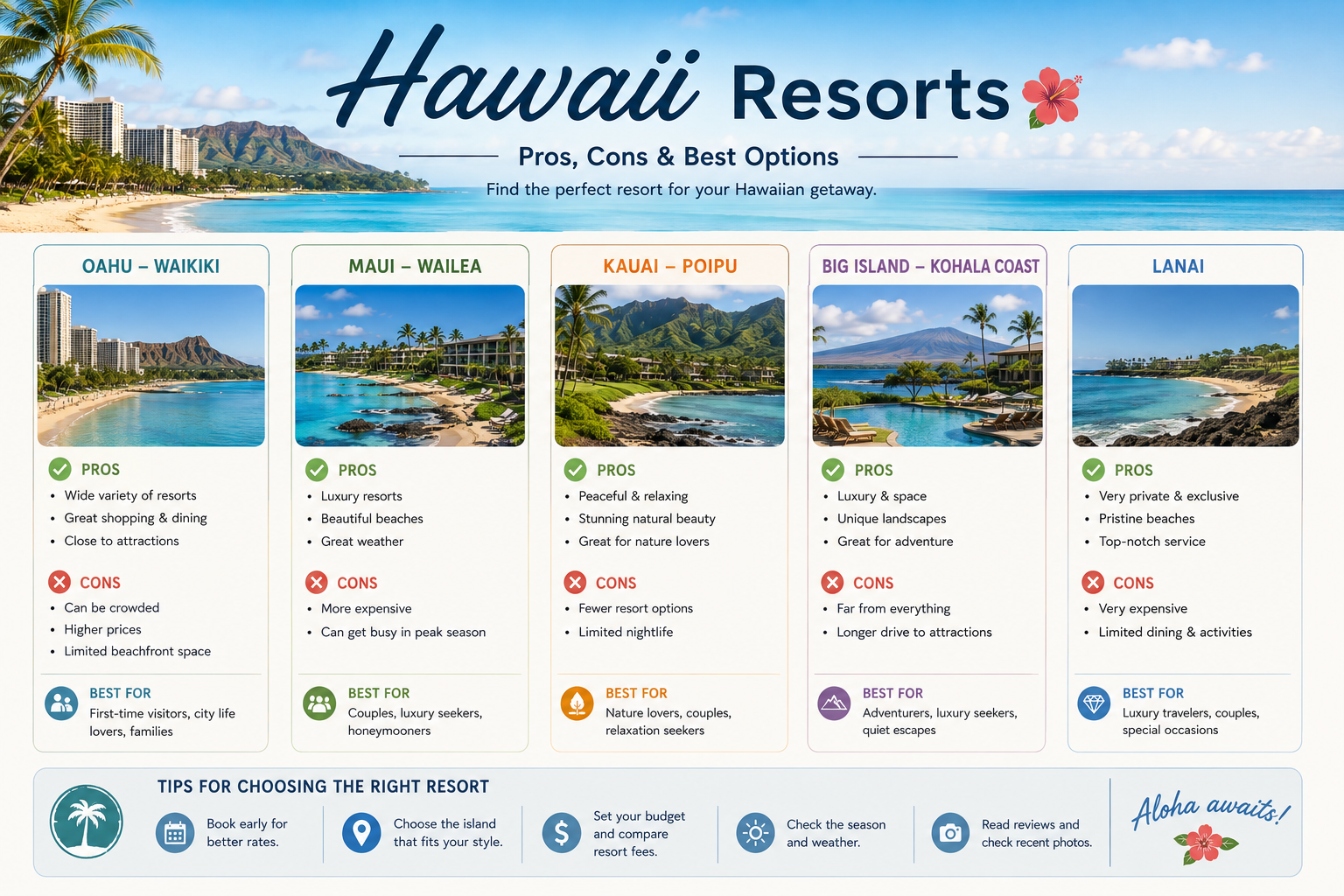
Hawaii’s resort scene ranges from genuinely spectacular to aggressively overpriced with a pool. Here’s how to tell the difference:
Pros of resorts: Beachfront access, pools, concierge services, on-site dining, reliable quality.
Cons of resorts: Resort fees ($35–$65/night on top of room rate), parking fees ($30–$50/day), inflated on-site dining prices, and a tendency to insulate you from authentic local Hawaii.
Best resort areas by island:
- Maui: Wailea (luxury — Four Seasons, Andaz, Fairmont) and Ka’anapali (full range — luxury to mid-range)
- Oahu: Waikiki (urban beach resort strip — Moana Surfrider, Royal Hawaiian, Hilton Hawaiian Village), Ko Olina (family-focused, quieter)
- Big Island: Kohala Coast (luxury resort row — Fairmont Orchid, Mauna Kea Beach Hotel)
- Kauai: Poipu (south shore, sunny) and Princeville (north shore, dramatic)
Vacation Rentals & Condos (VRBO/Airbnb)
For families, longer stays, and budget-conscious travelers, vacation rentals in Hawaii are often significantly better value than hotels — especially when you factor in the ability to cook meals.
Important: Hawaii has implemented strict short-term vacation rental regulations. In Maui County, many vacation rentals in residential areas have been banned or restricted post-2023 wildfires as part of the housing recovery effort. Always verify a rental’s legal permit status before booking. Look for listings that explicitly state their STR permit number.
Best for:
- Families (need space and a kitchen)
- Stays of 7+ nights (weekly rates offer better value)
- Travelers wanting to live like a local rather than a tourist
Boutique Hotels & B&Bs
Hawaii has a wonderful collection of smaller, independently owned accommodations that deliver more character and local personality than any chain property. The Ka’anapali Beach Hotel on Maui is legendary for this — called the most “Hawaiian” hotel on the strip by longtime visitors. Upcountry Maui’s bed and breakfasts, Kauai’s plantation-era cottages, and Hilo’s historic hotels on the Big Island are all excellent boutique alternatives.
Resort Fee Warning — What You Need to Know
This is the #1 Hawaii accommodation frustration among travelers.
Many Hawaii hotels advertise rates of $200–$300/night and then add a resort fee of $35–$65/night at checkout — on top of taxes (Hawaii’s general excise tax + transient accommodations tax adds roughly 18% to hotel bills). Your $250/night room actually costs $320–$340/night all-in.
How to avoid surprise: Before booking any Hawaii hotel, Google “[hotel name] resort fee 2026” to find the current resort fee. Factor it into your total before comparing properties.
Step 6 — Plan Your Transportation
Do You Need a Rental Car in Hawaii?
In short — yes, on almost every island.
Hawaii’s public transit infrastructure outside of Oahu is extremely limited. On Maui, the Big Island, and Kauai, there is no practical way to reach beaches, hiking trails, state parks, or most attractions without a car. If you plan to explore — and you should — you need wheels.
The exception: If you’re staying exclusively in Waikiki and have no plans to leave the resort strip, you can survive on Oahu’s bus system and rideshare. But even on Oahu, a rental car unlocks the North Shore, the Ko’olau Mountains, and the real island.
Renting a Car — Tips, Costs & Best Booking Strategy
Cost range: $60–$90/day for a compact; $90–$150/day for a mid-size SUV; higher in peak season.
Pro tips:
- Book your rental car at the same time as your flights — Hawaii rental car prices rise steeply with demand, and last-minute bookings during peak season can run $150–$250+/day.
- Book directly with the rental company — third-party sites often add hidden fees.
- Compact SUVs and 4WDs are recommended for Maui (Road to Hana), Big Island (lava fields, Saddle Road), and Kauai (some north shore roads) — paved surfaces can be narrow and rough.
- Understand the insurance situation: Hawaii is a no-fault state. Check whether your credit card or personal auto insurance covers rental cars before purchasing the rental company’s collision coverage.
- Under-25 drivers: Young driver fees apply but young drivers CAN rent cars in Hawaii. Factor this cost into your budget.
- Convertibles on Maui: As tempting as it sounds, the Road to Hana involves long stretches of rain, tunnel-like rainforest canopy dripping water, and zero shade — a convertible gets old fast on that drive.
Rideshare (Uber/Lyft) in Hawaii
Uber and Lyft operate on Oahu, Maui, and the Big Island. Coverage is reliable in resort areas but inconsistent in rural zones. During peak hours and after evening shows (like after a luau or HĀ at the PCC), surge pricing can make rides expensive.
Use rideshare for airport transfers and resort-area evenings. Rely on your rental car for everything else.
Public Transportation by Island
| Island | Public Transit | Verdict |
|---|---|---|
| Oahu | TheBus — comprehensive, cheap ($2.75/ride, $5.50 day pass) | ✅ Usable for Waikiki area; limited for North Shore |
| Maui | Maui Bus — very limited routes | ❌ Not practical for exploration |
| Big Island | Hele-On Bus — infrequent, long waits | ❌ Not practical for exploration |
| Kauai | Kauai Bus — limited coverage | ❌ Not practical for exploration |
Inter-Island Flights
Inter-island flights run 25–45 minutes and are operated primarily by Hawaiian Airlines (Alaska Air Group) on its Boeing 717 fleet. Mokulele Airlines serves Molokai and Lanai routes.
Book inter-island segments at the same time as your mainland flights — prices are lowest at initial booking and rise with demand. Expect to pay $39–$130 per segment when booked in advance, $150–$250+ last minute.
Build buffer days around inter-island travel. As Tropical Storm Lala demonstrated in August 2026 — canceling over 100 neighbor island flights in a single weekend — Hawaii weather can strand island hoppers with zero notice.
Step 7 — Build Your Hawaii Itinerary
One Week in Hawaii — Best Itinerary Options
Option A: Maui in 7 Days — Best Single-Island Experience
| Day | Activity |
|---|---|
| Day 1 | Arrive OGG, check in, explore Kihei/Wailea beach, sunset at Ka’anapali |
| Day 2 | Haleakalā National Park sunrise (book reservations at recreation.gov) + afternoon hike |
| Day 3 | Road to Hana — leave by 7am, full day, stay in Hana overnight if budget allows |
| Day 4 | Return from Hana, Wai’ānapanapa black sand beach, Twin Falls |
| Day 5 | Molokini Crater snorkel tour (morning) + Wailea beach afternoon |
| Day 6 | Upcountry Maui — lavender farms, Tedeschi Winery, Makawao town, malasadas at Komoda |
| Day 7 | Ka’anapali Beach, local lunch in Paia, sunset at West Maui, depart |
Option B: Oahu in 7 Days — Best Cultural + Urban Experience
| Day | Activity |
|---|---|
| Day 1 | Arrive HNL, Waikiki Beach orientation, sunset at Kaimana Beach |
| Day 2 | Pearl Harbor (book tickets 2–3 months ahead) + Bishop Museum |
| Day 3 | Diamond Head hike (early AM, book in advance) + Kaimuki lunch + Manoa Falls hike |
| Day 4 | North Shore day trip — Haleiwa town, Matsumoto shave ice, Sunset Beach, food trucks |
| Day 5 | Polynesian Cultural Center (full day — noon to 9pm including HĀ evening show) |
| Day 6 | Windward Oahu — Kailua Beach, Lanikai Pillbox hike, Kaneohe Bay |
| Day 7 | Chinatown Honolulu food tour, Ala Moana, last sunset on Waikiki |
Two Weeks in Hawaii — Complete Island Hopper Plan
Oahu (Days 1–5) + Maui (Days 6–14)
| Days | Island | Focus |
|---|---|---|
| Days 1–5 | Oahu | Pearl Harbor, Diamond Head, North Shore, PCC, Windward |
| Day 6 | Travel | HNL → OGG (40-min flight) — check in, beach afternoon |
| Days 7–8 | Maui | Road to Hana (2-day option — stay overnight in Hana) |
| Day 9 | Maui | Haleakalā National Park sunrise + summit hike |
| Day 10 | Maui | Molokini Crater snorkel + Wailea afternoon |
| Days 11–12 | Maui | Upcountry, West Maui beaches, whale watching (if in season) |
| Day 13 | Maui | Beach day, last local meals, sunset at Black Rock |
| Day 14 | Depart OGG |
Hawaii with Kids — Family-Specific Planning
Best islands for families: Oahu (most family infrastructure) and Maui (beautiful beaches with calmer conditions at Ka’anapali and Wailea).
Key family planning tips:
- Book Pearl Harbor tickets 2–3 months in advance — they sell out
- The Polynesian Cultural Center is exceptional for kids of all ages — interactive, hands-on, engaging
- Wailea Beach (Maui) and Kailua Beach (Oahu) both offer calm, clear, family-safe swimming conditions
- Rent a condo with a kitchen — feeding a family three meals a day at Hawaii restaurant prices adds up very fast
- The Maui Ocean Center in Maalaea is an excellent rainy-day activity and genuinely world-class marine aquarium
- Book early — family-size accommodation in Hawaii disappears quickly during summer
Hawaii Honeymoon — Romantic Itinerary Framework
Best combination: Maui (5 days) + Lanai (2 days)
Maui’s Wailea resort strip provides the ideal honeymoon base — luxury accommodation, perfect beaches, spectacular sunsets, and the Road to Hana as a day-trip adventure. Add a 2-night escape to Lanai’s Four Seasons for ultimate seclusion — take the ferry from Lahaina Harbor (45 minutes) and leave the rest of the world behind entirely.
Romantic highlights:
- Sunrise at Haleakalā (book 3–4 months ahead during peak season)
- Private snorkel charter at Molokini Crater
- Sunset dinner at Mama’s Fish House (book 4–6 weeks in advance minimum)
- Stargazing from Haleakalā summit at night (tours available)
- Couples spa treatment at the Four Seasons Wailea or Andaz Maui
Hawaii on a Budget — Itinerary Built Around Free Activities
The great secret of Hawaii travel: the best experiences are free.
Free and near-free Hawaii activities:
- Every beach in Hawaii — by law, all Hawaii beaches are publicly accessible
- Diamond Head hike — $5 per person reservation fee, one of the greatest hikes in America
- Manoa Falls (Oahu) — small parking/entry fee, extraordinary waterfall in urban Honolulu
- Road to Hana — drive it in a day from Kahului, many stops are free
- Waimea Canyon (Kauai) — $25 park entry per vehicle (5 passengers), absolutely worth every cent
- Sunrise at Haleakalā — requires advance timed entry reservation but is free once reserved
- All Big Island state beaches — Punaluu Black Sand Beach and most others are free
- Farmers markets across all islands — free to browse, cheap to eat
Budget week on the Big Island: Stay in a Hilo Airbnb ($80–$120/night), rent a small car ($60/day), eat from farmers markets and the Hilo Bay Café, visit Hawaii Volcanoes National Park ($25/vehicle/week), hike to Green Sand Beach, swim at Punaluu. Total daily spend outside accommodation and car: easily under $40/person.
Step 8 — Understand Hawaii’s Food Scene
Must-Try Hawaiian Dishes Before You Arrive
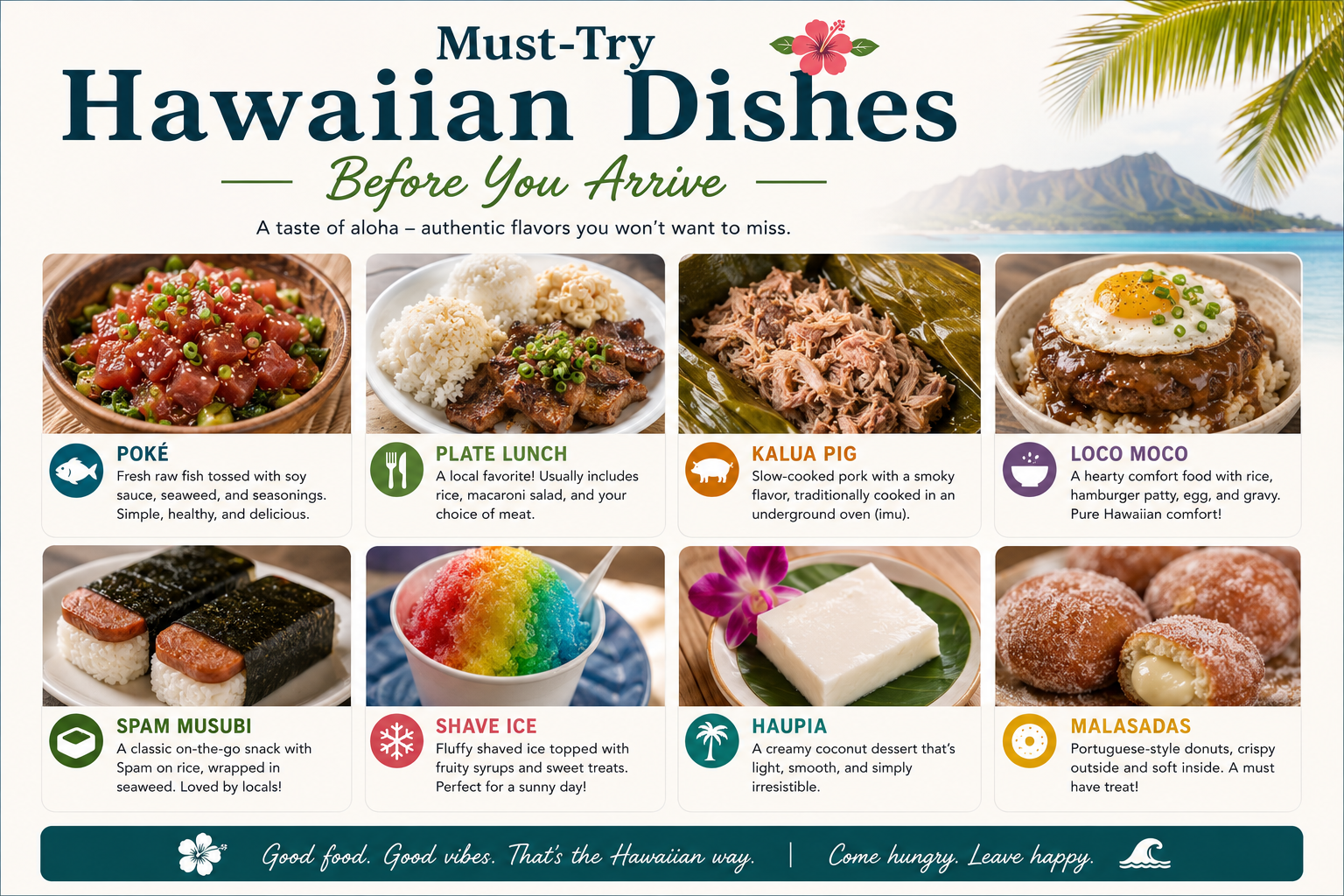
Hawaii’s food scene is a genuine culinary destination — a product of the islands’ multicultural history, extraordinary fresh seafood, and year-round access to tropical produce.
The essential Hawaii food list:
- Poke bowl — fresh ahi tuna, soy, sesame, green onion over rice. Order it from a local fish market, not a resort
- Plate lunch — two scoops rice, one scoop mac salad, your choice of protein. The soul of local eating
- Loco moco — rice, hamburger patty, fried egg, brown gravy. Sounds absurd. Tastes extraordinary
- Spam musubi — rice + spam wrapped in nori. Find it at any convenience store. It’s $2–$4 and genuinely delicious
- Shave ice — not a snow cone. Find Ululani’s on Maui or Waiola Shave Ice on Oahu
- Kalua pork — whole pig slow-cooked in an underground imu oven. Best at a proper luau
- Malasadas — Portuguese doughnuts, best fresh and hot. T. Komoda Store on Maui, Leonard’s Bakery on Oahu
For the complete guide to Hawaiian cuisine — with specific restaurant recommendations on every island — read our Hawaiian Food Guide: 20 Must-Try Dishes →
Where Locals Actually Eat
The best food in Hawaii is almost never at the resort.
Locals eat at plate lunch spots, food trucks, farmer markets, and the kind of counter-service restaurants that have been serving the same recipes since the 1950s. Sam Sato’s in Wailuku (Maui), Helena’s Hawaiian Food in Honolulu, and Ken’s House of Pancakes in Hilo are the kinds of institutions no travel influencer is going to tell you to visit — because there’s nothing Instagram-worthy about a linoleum floor and a paper plate. But the food is extraordinary.
The $15 rule: Never dismiss a Hawaii meal because it costs $15 and has no table service. Some of the most memorable food experiences in Hawaii cost under $20.
Food Budget Tips for Hawaii
- Grocery stores (Times, Foodland, Safeway) all have excellent local food sections — poke counters, plate lunch, local pastries
- Costco on Oahu and Maui is an excellent resource for families — reasonable prices on everything
- Farmers markets on every island offer fresh tropical fruit for $2–$5 that would cost $15 at a resort
- Ask your hotel staff where they eat lunch. Not where they’re told to send tourists. Where they actually go.
Step 9 — Pack for Hawaii
Complete Hawaii Packing List
Clothing:
- Lightweight shirts/t-shirts — 1 per day plus 2 extras
- Shorts — 3–4 pairs
- Swimsuits — 2–3 (so one is always dry)
- Rash guard — essential for sun protection during water activities
- Light rain jacket or packable windbreaker — for Haleakalā summit, Road to Hana, Kauai
- One smart-casual outfit — for nicer restaurants (Mama’s Fish House, Four Seasons)
- Comfortable walking shoes — trails, towns, markets
- Water shoes or reef walkers — for lava fields, rocky entries, snorkeling
- Flip flops — for beach, pool, casual wear
Sun & Ocean:
- Reef-safe sunscreen (SPF 30+) — Hawaii law requires this. More on this below.
- Sunglasses with UV protection
- Wide-brim hat or baseball cap
- Snorkel mask and fins — if you plan to snorkel more than once, buying your own is cheaper than renting repeatedly
Tech & Gear:
- Portable phone battery bank — essential for long hike days and storm emergencies
- Waterproof phone case or dry bag — streams, snorkeling, kayaking
- Offline maps downloaded — Google Maps works offline if you pre-download the area. Cell service is nonexistent on parts of the Road to Hana and much of Molokai
- Action camera (GoPro or equivalent) — for snorkeling and waterfall hikes
- Car phone mount — for navigation while driving
Practical:
- Reusable water bottle — large (64oz+). Hawaii is hot and trails have no water sources
- Small day pack/backpack — for hikes and beach days
- Copies of important documents (passport, insurance, reservations) in a waterproof bag
- Cash — some rural markets, food trucks, and state park parking accepts cash only
- First aid kit — blister bandages are the most-used item
What NOT to Bring to Hawaii
- ❌ Non-reef-safe sunscreen — illegal in Hawaii and will be confiscated at some parks
- ❌ Snake (obviously) — importing snakes to Hawaii is a serious federal crime
- ❌ Certain fruits and plants — Hawaii has strict agricultural inspection at airports. Don’t attempt to bring fresh fruit or plants from the mainland or from island to island
- ❌ Heavy formal wear — Hawaii is extraordinarily casual. A linen shirt and shorts is appropriate for almost every occasion
- ❌ High heels — virtually useless in Hawaii. Leave them home
- ❌ More shoes than you need — walking shoes, water shoes, flip flops. That’s it.
Reef-Safe Sunscreen — Hawaii’s Law
Hawaii was the first U.S. state to ban sunscreens containing oxybenzone and octinoxate — chemicals proven to cause coral bleaching and reef damage at extremely small concentrations.
This is not a suggestion — it is state law, effective since January 1, 2021.
Look for sunscreens labeled “reef-safe” with zinc oxide or titanium dioxide as active ingredients. Brands like Stream2Sea, Raw Elements, and Thinksport are widely available and genuinely effective. You can also buy reef-safe sunscreen at any pharmacy or grocery store on the islands.
Pro tip: Apply sunscreen 20 minutes before entering the water and avoid spray sunscreens near the ocean — they drift and settle on reef surfaces.
Step 10 — Know the Safety Rules
This section is not optional. Hawaii’s natural beauty comes with genuine hazards that kill visitors every year — mostly because they didn’t know the rules.
Ocean Safety — Hawaii’s #1 Tourist Risk
Drowning is the leading cause of accidental death for visitors to Hawaii. The Pacific Ocean is not a swimming pool — it is a powerful, dynamic body of water with currents, shore breaks, and wave sets that can knock an experienced swimmer off their feet without warning.
Non-negotiable ocean safety rules:
- Always obey beach warning flags. Yellow = caution. Red = danger, no swimming. These are set by trained ocean safety lifeguards who know that specific beach’s conditions that day.
- Never turn your back on the ocean. Sneaker waves hit beaches with no surf warning. They kill visitors every year.
- Never swim alone at an unguarded beach.
- If caught in a rip current — do not swim against it. Swim parallel to shore until you’re out of it, then return to the beach at an angle.
- Shore breaks are dangerous. Waves that break directly on the beach sand can slam you into the ground with enough force to break your neck. This is especially common on Oahu’s Makapuu and Sandy Beach. Watch carefully before entering.
- Check surf reports at surf-forecast.com or the Magic Seaweed app before going in the water at any north or east shore beach.
Hiking & Trail Safety
Hawaii has extraordinary hiking — and several trails that have cost unprepared visitors their lives.
Key hiking safety rules:
- Never hike to waterfalls during or immediately after rain. Flash floods turn dry stream beds into walls of water in minutes.
- Always tell someone your hiking plan and expected return time before heading out.
- Download offline maps before you leave cell service — much of Maui’s east side and Kauai’s north shore have zero coverage.
- Bring more water than you think you need — 1 liter per hour of hiking in tropical heat.
- If you hear a roaring sound from upstream on a stream trail, move immediately to high ground. Do not wait to see the water.
Flash Flooding & Weather Emergencies
Hawaii’s flash flooding is faster, more violent, and more unpredictable than most visitors realize. In March 2026, flash floods on Oahu’s North Shore became the worst in 20 years — hundreds of homes were damaged, 5,500 people were evacuated, and the Wahiawā Dam came within inches of the evacuation trigger level.
What to do:
- Sign up for emergency alerts before your trip at ready.hawaii.gov/alerts
- Bookmark weather.gov/hfo for real-time NWS Honolulu warnings
- If a Flash Flood Warning is issued — stay at your accommodation, do not drive, do not hike
- Never drive through flooded roads. Six inches of moving water can knock you down. Two feet can sweep your car away.
For complete flash flooding guidance, read our Hawaii Flash Flooding Safety Guide
Wildlife Safety — Turtles, Seals & Whales
Hawaii’s wildlife is protected by federal law. Violations carry serious fines.
| Animal | Legal Distance | Note |
|---|---|---|
| Hawaiian Green Sea Turtle (Honu) | 10 feet minimum | Never touch, chase, or block their path to the water |
| Hawaiian Monk Seal | 50 feet minimum | Never approach. They look calm. They are not. |
| Humpback Whale | 100 yards minimum | Federal law — applies to boats, paddleboards, and swimmers |
| Nēnē (Hawaiian Goose) | Do not feed | Feeding causes dependency and disrupts natural behavior |
If you see a tourist violating these rules, you can report it to DLNR at dlnr.hawaii.gov.
Travel Insurance for Hawaii — Is It Worth It?
Yes — especially if your trip includes:
- Inter-island flights (extremely vulnerable to weather cancellations)
- A narrow travel window (specific vacation days you cannot easily change)
- Major life events (honeymoon, anniversary, milestone birthday)
- Hiking or water sports activities
A comprehensive travel insurance policy should cover:
- Trip cancellation for weather events
- Trip interruption if a storm strands you mid-trip
- Emergency medical and evacuation (helicopter evacuations from Hawaii trails cost $5,000–$30,000)
- Missed connection coverage for inter-island disruptions
Critical rule: Buy travel insurance at the time of your initial booking. Once a weather event or storm is “named” or “known,” it is excluded from new policies.
Hawaii Travel Tips — Insider Knowledge
20 Things to Know Before You Go to Hawaii
Logistics:
- Book everything early — Hawaii is not a destination that rewards spontaneity. Hotels, rental cars, popular restaurants, sunrise reservations, and Pearl Harbor tickets all sell out weeks to months in advance.
- Hawaii uses its own time zone — Hawaii-Aleutian Standard Time (HST). Hawaii does NOT observe daylight saving time. During summer (when the mainland springs forward), Hawaii is 3 hours behind Pacific time and 6 hours behind Eastern. In winter, it’s 2 and 5 hours respectively.
- Cell service varies dramatically — you will lose service on parts of the Road to Hana, much of rural Kauai, and most of Molokai. Download offline maps before you leave your hotel.
- Parking costs money at most popular attractions — Diamond Head, Wai’ānapanapa, and many North Shore spots charge parking fees. Some require advance reservations. Budget for this.
- Tipping is standard — Hawaii service workers depend on tips. Standard restaurant tipping is 18–20%. Tour guides, drivers, and activity staff appreciate $5–$20 depending on the experience.
Cultural: 6. Take your shoes off before entering homes — this is standard practice across all Hawaiian islands, rooted in both local custom and Japanese cultural influence. Always follow the lead of your host. 7. “Haole” is not an insult, but context matters — it simply means “foreigner” and has a complex history. Approach it with curiosity rather than defensiveness. 8. The Aloha Spirit is codified in Hawaiian law — it is not just a slogan. Reciprocate it genuinely. 9. Don’t call it “The Big Island of Hawaii” in a way that implies Hawaii is only one island — Hawaii is the official name of the 50th state, and also the name of the largest island. “Big Island” is the casual shorthand for the island of Hawaii specifically. Just a nuance worth knowing. 10. Hawaiian is an official state language — alongside English. Many streets, parks, and landmarks have Hawaiian names. Learn to pronounce them — Hawaiians genuinely appreciate the effort.
Nature & Safety: 11. The ocean is always more powerful than it looks — even on calm days. 12. Clouds on the mountains mean rain is coming — if you see dark clouds building over the Ko’olau Mountains (Oahu) or Haleakalā (Maui), it is raining up there. If you’re near a stream, move away from it. 13. Volcanic fog (vog) is real on the Big Island — if you have respiratory issues, check USGS air quality alerts before visiting Volcano National Park. 14. Green flash sunsets are real — if you’re on a west-facing beach on a clear evening and the horizon is sharp, watch the last sliver of sun as it sets. The green flash lasts less than a second. You’ll never forget it. 15. Sunrise on Haleakalā requires advance reservations — months in advance during peak season. Book at recreation.gov the moment your trip dates are confirmed.
Money & Practicalities: 16. Resort fees are real and significant — always factor them in before comparing accommodation prices. See Step 5 for details. 17. Gas is more expensive in Hawaii than the mainland — especially on neighbor islands (Maui, Kauai, Big Island), where it can run $0.40–$0.80 more per gallon than Oahu. Factor this into your budget if you’re driving extensively. 18. Grocery prices are 15–30% higher than the mainland — most food is shipped or flown in. Fresh local produce from farmers markets is the exception. 19. The plate lunch is the most important meal in Hawaii — it is the cultural heart of local food. Have at least one authentic plate lunch before you leave. 20. You will want to come back — budget for it now. Hawaii is not a once-in-a-lifetime destination. It is a come-back-every-year destination. Plan your first trip well and the second one becomes inevitable.
Common Tourist Mistakes to Avoid
- Underestimating drive times — Google Maps in Hawaii often underestimates how long it takes to get somewhere. The Road to Hana is 64 miles but takes 3+ hours one way. Add 30% to every estimated drive time.
- Booking the wrong beach — not all Hawaii beaches are appropriate for swimming. Always check conditions before entering the water, especially on north or east-facing shores.
- Not reserving Haleakalā sunrise — this is the #1 Maui regret of first-time visitors. You cannot just show up. Book months ahead at recreation.gov.
- Overpacking your itinerary — Hawaii works best when you slow down. Two or three things per day, maximum. Hawaii at a sprint is Hawaii missed.
- Ignoring the weather forecast — Hawaiian weather changes fast and the consequences of being caught in a flash flood or caught on a trail in a storm are serious. Check weather every morning.
How to Be a Respectful Visitor
Hawaii’s natural and cultural resources are finite and fragile. The choices you make as a visitor have a direct impact on the islands, the reefs, the wildlife, and the communities that live here year-round.
Practical ways to visit responsibly:
- Use reef-safe sunscreen — it is state law and genuinely matters for coral health
- Stay on marked trails — off-trail hiking causes erosion that can take decades to recover
- Support locally owned businesses — restaurants, shops, tour operators. Money spent locally stays in the community
- Book tours with responsible operators — look for operators who limit group sizes, follow wildlife regulations, and invest in conservation
- Take nothing, leave nothing — no sand, no shells, no lava rocks. Yes, the “lava rock curse” is folklore — but removing any part of Hawaii’s natural environment is actually illegal
- Learn the history — Hawaii’s relationship with the United States began with an illegal overthrow. Understanding this doesn’t diminish your experience; it deepens it
Hawaii Practical Information
Do I Need a Passport to Visit Hawaii?
No. Hawaii is the 50th U.S. state. American citizens need only a valid government-issued photo ID — a driver’s license is sufficient — to fly to Hawaii from the mainland.
International visitors must carry their passport, U.S. visa (if applicable), and ESTA authorization (if traveling from a Visa Waiver Program country). Standard U.S. Customs and Border Protection entry requirements apply at Honolulu International Airport for all international arrivals.
Currency, Tipping & Cost of Living
Hawaii uses the U.S. dollar. Credit and debit cards are accepted virtually everywhere. However, some farmers markets, food trucks, and rural parking areas are cash-only — bring $50–$100 in small bills.
Tipping culture: Standard in Hawaii, identical to mainland U.S. norms:
- Restaurants: 18–20%
- Bars: $1–$2 per drink
- Tour guides: $10–$20 per person for half-day tours; $20–$50 for full-day premium experiences
- Rideshare: 15–20% standard
- Hotel housekeeping: $3–$5 per night, left daily
Cell Service & Wi-Fi in Hawaii
Major carriers (AT&T, T-Mobile, Verizon) all provide reliable service in urban areas and resort zones. Coverage drops significantly on:
- Road to Hana (Maui) — multiple dead zones, especially past mile marker 30
- Rural Kauai (north shore and Waimea Canyon interior)
- Molokai (most of the island)
- Big Island’s Saddle Road and Volcano area
Solution: Download Google Maps offline for each island before you leave your hotel. Download Spotify playlists, podcasts, and entertainment ahead of any long drive.
Wi-Fi: Available in virtually all accommodation and most restaurants. Airport Wi-Fi is free at all major Hawaii airports.
Hawaii Time Zone
Hawaii uses Hawaii-Aleutian Standard Time (HST) — UTC−10:00.
Hawaii does NOT observe daylight saving time.
This means the time difference between Hawaii and the mainland changes twice a year:
- During U.S. standard time (Nov–Mar): Hawaii is 2 hours behind Pacific, 5 hours behind Eastern
- During U.S. daylight saving time (Mar–Nov): Hawaii is 3 hours behind Pacific, 6 hours behind Eastern
Driving Rules & Road Tips
- Drive on the right side of the road (standard U.S. rules)
- Speed limits on Hawaiian highways rarely exceed 55 mph. Rural roads are often 25–35 mph
- One-lane bridges — common on Maui’s Road to Hana. Yield to oncoming traffic following “yield” signs. Take turns
- Road closures — heavy rain can close roads with no warning. Always check Hawaii DOT’s Road Closures page before a long drive
- Parking at popular trailheads is limited and fills by sunrise. Either arrive very early or use shuttle services where available
- Never leave valuables visible in parked cars — car break-ins at trailheads are a documented problem on all islands
Your Complete Hawaii Planning Resource Library
Every guide you need to plan the perfect Hawaii trip — all in one place:
| Resource | What You’ll Learn | |
|---|---|---|
| Hawaiian Islands — Complete Guide | Which island to choose, island comparisons, geography, history | |
| Hawaii Airlines — Flight Guide | Every airline, every route, 2026 changes, cheapest fare tips | |
| Maui Island — Complete Travel Guide | Road to Hana, Haleakalā, beaches, where to stay | |
| Hawaiian Food — 20 Must-Try Dishes | Poke, kalua pork, plate lunch, shave ice, malasadas | |
| Hawaii Flash Flooding — Safety Guide | Weather risks, emergency alerts, what to do | |
| Polynesian Cultural Center — Visitor Guide | Tickets, packages, villages, luau, HĀ evening show | |
| Oahu Travel Guide (coming soon) | Waikiki, Pearl Harbor, North Shore, complete Oahu planning |
Frequently Asked Questions About Visiting Hawaii
Q: How much does a trip to Hawaii cost in 2026? A: A mid-range Hawaii trip costs approximately $250–$400 per person per day once you’re on the island, including accommodation, food, car rental, and activities. Flights from the West Coast add $300–$600 round trip per person; from the East Coast, $500–$900. A 7-day trip for two people with West Coast flights typically totals $3,500–$6,000 all-in at the mid-range level. Budget travelers can manage on $150–$200/person/day with careful planning.
Q: What is the best Hawaiian island for a first-time visitor? A: Oahu is the best Hawaiian island for first-time visitors — it offers the most diverse range of experiences, the most developed infrastructure, and the easiest entry point into Hawaiian culture. Maui is an excellent alternative for first-timers who prioritize beach beauty and resort comfort over urban variety.
Q: How far in advance should I book my Hawaii trip? A: For summer travel (June–August), book flights and accommodation 4–6 months ahead. For holiday season (December–January), 5–6 months ahead. Shoulder season trips (April–May, September–October) can be planned 6–10 weeks out, though car rentals should be booked earlier. Always reserve Haleakalā sunrise, Pearl Harbor tickets, and popular restaurants the moment your dates are confirmed.
Q: Do I need a rental car in Hawaii? A: Yes, on almost all islands. Hawaii’s public transportation outside of Oahu is extremely limited. A rental car is essential on Maui, the Big Island, and Kauai for accessing beaches, hiking trails, and attractions. Book at the same time as your flights — prices rise sharply with demand and last-minute rentals during peak season can cost $150–$250+/day.
Q: How many days do you need in Hawaii? A: A minimum of 7 days for a single island. The Hawaii Tourism Authority reports the average visitor stay in 2025 was approximately 9 days. For a two-island itinerary, 10–12 days is realistic. Remember: Hawaii rewards slow travel. More days spent on fewer islands consistently produces better trip experiences.
Q: What should I pack for Hawaii? A: The essentials: reef-safe sunscreen (required by state law), rash guard, multiple swimsuits, water shoes, a light rain layer, comfortable walking shoes, a large reusable water bottle, waterproof phone case, and a portable battery bank. Full packing list above in Step 9.
Q: Is Hawaii safe for tourists? A: Hawaii is generally very safe. The primary safety risks are ocean-related — strong currents, shore breaks, and high surf cause the majority of visitor accidents and fatalities. Respect beach warning flags, never turn your back on the ocean, and check surf conditions before entering the water. Hiking safety and flash flood awareness are also important — see Step 10 for complete safety guidance.
Q: What is the best time of year to visit Hawaii? A: April–May and September–November offer the best combination of excellent weather, fewer crowds, and lower prices. Avoid the two peak seasons (June–August and December–January) if budget and crowd avoidance are priorities. If whale watching is your goal, plan for December through April.
Q: What food is Hawaii most famous for? A: Poke bowls, kalua pork, plate lunch, loco moco, spam musubi, shave ice, and malasadas are the dishes most associated with Hawaii. For the complete food guide with restaurant recommendations, read our Hawaiian Food Guide →
Q: Can I visit multiple Hawaiian islands in one trip? A: Yes — and it’s highly recommended if you have 10 days or more. Inter-island flights are short (25–45 minutes) and affordable when booked in advance. The most popular two-island combination for first-timers is Oahu + Maui. For nature lovers, Big Island + Kauai is extraordinary. Always build buffer days around inter-island travel in case of weather-related cancellations.
Final Thoughts — Your Hawaii Trip Starts Here
Here’s the truth about planning a Hawaii trip: the people who love Hawaii the most aren’t the ones who stayed at the nicest resort or took the most Instagram-worthy photos. They’re the ones who slowed down, ate where locals eat, learned a few Hawaiian words, watched the sunrise from a volcano, and left with a genuine respect for the place they visited.
Hawaii is not a backdrop. It is a living, breathing collection of islands with a complex history, a resilient culture, extraordinary natural beauty, and communities of people who choose to share it with millions of visitors every year with remarkable generosity.
Plan well. Arrive curious. Spend money in the community. Take the long hike. Try the plate lunch. Watch the sun set over the Pacific with nothing in your hand except maybe a shave ice.
You came all this way. Make it count.