
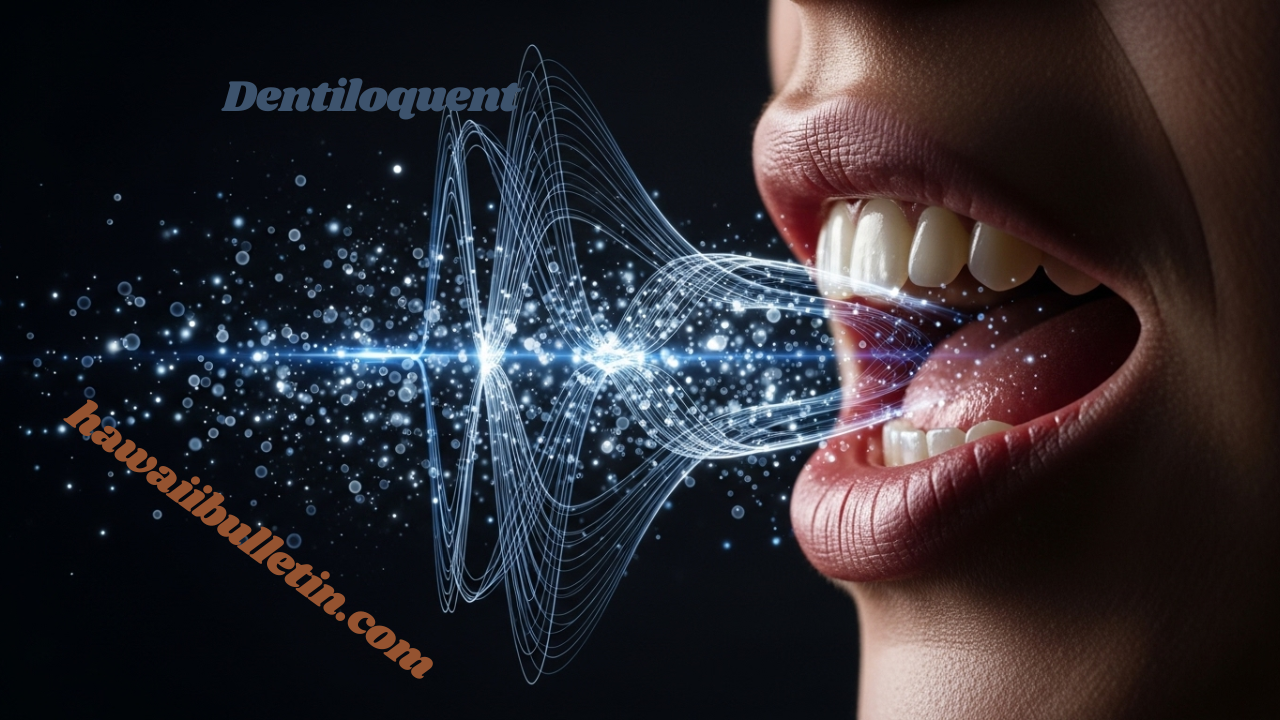
Introduction: What Does It Mean to Be Dentiloquent?
In a world saturated with communication, from tweets to TED Talks, the power of precise speech remains paramount. Yet, there exists a wonderfully obscure word that captures a very specific facet of oratory: dentiloquent. To be dentiloquent (pronounced den-TIL-oh-kwent) is to speak from the teeth—to articulate words with clear, distinct, and often emphatic enunciation. It implies speech that is clipped, precise, and driven by the mechanical action of the teeth and jaw. Far from being just a linguistic curiosity, the concept of dentiloquence opens a fascinating window into the anatomy of speech, the history of rhetoric, and the subtle tools we use to command attention. This article will explore the roots of this rare term, its practical applications, and why cultivating a degree of dentiloquence might be one of the most powerful communication skills you can develop.
The Etymology and Historical Context of Dentiloquence
The word dentiloquent is a blend of Latin roots: denti- (tooth) and loqui (to speak). It belongs to a family of delightful and specific words describing manners of speech, such as:
-
Ventriloquist: One who “speaks from the stomach.”
-
Somniloquist: One who talks in their sleep.
-
Magniloquent: Speaking in a grand, lofty style.
While “dentiloquent” itself isn’t found in the everyday lexicons of ancient Rome or Greece, the practice it describes was highly valued. Classical rhetoricians like Cicero and Quintilian dedicated significant portions of their work to delivery (pronuntiatio), which included precise articulation. They understood that persuasive power wasn’t just in the words (verba) but in their sound and physical formation. A mumbling orator would lose the forum just as quickly as a illogical one.
In the 19th and early 20th centuries, as elocution became a formal discipline, the clarity implied by dentiloquent speech was the gold standard for actors, politicians, and public speakers. It was the antidote to slovenly speech and the key to being understood in large halls before the advent of electronic amplification.
The Anatomy of Dentiloquent Speech: More Than Just Teeth
To truly grasp the concept, it’s helpful to understand the mechanics. Dentiloquent articulation involves a conscious engagement of the articulators:
-
The Teeth: Act as a precise barrier or guide for the tongue to create sounds like th (as in “thin” or “this”), *f*, and *v*.
-
The Tongue: Works in tandem with the teeth and alveolar ridge (just behind the upper teeth) to produce crisp *t*, *d*, *s*, *z*, and *l* sounds.
-
The Jaw: A tense or barely-open jaw mutes sound; a deliberately mobile jaw allows for fuller vowel sounds and clearer consonant formation.
When someone is described as speaking in a dentiloquent manner, you can almost see the precision in their mouth movements. It’s speech that is visually and aurally sharp. Think of classic film stars like Katharine Hepburn or James Cagney, whose dialogue crackles with clarity, or modern figures like actor Tom Hiddleston, renowned for his precise diction.
Dentiloquence in the Modern World: Where Precision Matters
You might wonder if such an archaic-sounding skill has any place today. The answer is a resounding yes, in several key areas:
-
Public Speaking and Leadership: Leaders who enunciate clearly are perceived as more confident, competent, and trustworthy. Dentiloquent delivery ensures that every word of a keynote, pitch, or critical announcement lands with its intended force.
-
Voice Acting and Audiobooks: In audio-only media, clarity is everything. A voice actor’s ability to be distinctly dentiloquent can define a character or keep a listener engaged for hours.
-
Customer-Facing Roles: From therapists to luxury concierges, professionals who speak with careful articulation convey respect, attention, and expertise.
-
Non-Native Speaker Communication: Slurred or mumbled speech is a significant barrier. Focusing on clear, dentiloquent articulation can dramatically improve intelligibility for English language learners.
-
Theatre and Film: Even with modern microphones, actors use precise articulation to convey character, period, and emotion. A Shakespearean soliloquy demands a different level of oral precision than a casual conversation, but both benefit from control.
The Fine Line: Dentiloquence vs. Over-Enunciation
It’s crucial to distinguish effective dentiloquent speech from its caricature: overly precise, stilted, or pedantic enunciation that can sound artificial or condescending. The goal is not to sound like a 1930s elocution teacher, but to harness that clarity for authentic communication.
The key is context and intent. A newscaster reporting on a crisis will use sharper, more dentiloquent tones to convey gravity and ensure understanding. The same newscaster telling a lighthearted story on a talk show will relax their articulation to sound conversational. Effective communicators code-switch between degrees of dentiloquence seamlessly.
How to Cultivate Your Own Dentiloquent Clarity
Improving your articulation is a accessible goal. Here are some practical exercises to introduce more purposeful dentiloquent precision into your speech:
-
Consonant Drills: Exaggerate consonant sounds, especially plosives (p, b, t, d, k, g) and fricatives (f, v, th, s, z).
-
Practice Phrase: “The tip of the tongue, the teeth, the lips.” (Repeat slowly, focusing on each point of contact).
-
-
Classic Tongue Twisters: These are designed to train articulation. Go slowly at first, then build speed while maintaining clarity.
-
Examples: “She sells sea-shells by the sea-shore.” / “Peter Piper picked a peck of pickled peppers.”
-
-
The Pencil Exercise: Place a pencil horizontally in your mouth, gripping it with your teeth. Read a paragraph aloud. The obstacle forces exaggerated jaw and lip movement. Remove the pencil and read again—you’ll notice a new ease and clarity.
-
Record and Listen: Record yourself reading a complex text. Listen back critically. Where do you mumble or slur words? Target those sounds.
-
Intentional Slow Reading: Choose a poem or a piece of prose and read it aloud at half your normal speed, giving each phoneme its full value. This builds muscle memory for clear formation.
Beyond the Teeth: The Holistic Picture of Powerful Speech
While our focus is on dentiloquence, true powerful speech integrates multiple elements:
-
Breath Support: Clear articulation is wasted on a weak, airy voice. Strong breath from the diaphragm provides the power.
-
Pacing and Pause: Strategic pauses give your precise words space to resonate and be processed.
-
Pitch and Melody: A monotone, even if perfectly articulated, is dull. Variation in pitch creates interest and emotion.
-
Intent and Authenticity: All the technique in the world fails without genuine connection to your message and audience.
Dentiloquent articulation is the sharp, clean edge of the tool—but the tool itself is your full vocal presence.
Conclusion: Reclaiming the Lost Art of Clear Speech
In our fast-paced, text-heavy digital age, the physical art of speech can become an afterthought. We prioritize speed over clarity, informality over impact. Rediscovering the principle of dentiloquence is not about becoming formal or artificial; it’s about reclaiming a superpower.
It is an act of respect for your listener and your own message. Whether you’re leading a team meeting, recording a podcast, or simply wanting to tell a story more vividly, a touch of conscious dentiloquent precision can make all the difference.
Call to Action: Find Your Voice
The journey to more powerful communication begins with a single, clearly spoken word. We challenge you to one dentiloquent act today:
-
Engage: Leave a comment below sharing your thoughts on clear communication.
-
Practice: Pick one of the articulation exercises above (try the pencil trick—it’s enlightening!) and spend just five minutes with it today.
-
Observe: For the next 24 hours, be an auditor of articulation. Listen to a news anchor, a favorite audiobook narrator, or a colleague. Can you hear the elements of dentiloquent speech? What impact does it have?