Table of Contents
- What Makes Kauai Unlike Any Other Hawaiian Island?
- Best Time to Visit Kauai, Hawaii
- Getting to Kauai
- Getting Around Kauai
- Top Things to Do in Kauai
- Best Beaches in Kauai
- Best Hikes in Kauai
- Where to Stay in Kauai
- Where to Eat in Kauai
- Travel Tips & Practical Information
- Kauai vs. Other Hawaiian Islands
- Frequently Asked Questions
- Final Thoughts
Introduction
Some islands promise paradise. Kauai delivers it.
The moment you fly over the island on approach to Lihue Airport, something shifts. The landscape below you stops looking real. Knife-edge ridges covered in dark green jungle. Waterfalls pouring off cliff faces with nowhere to go but straight down. A coastline so dramatic it has no road — just cliffs and ocean and silence.
This is Kauai, Hawaii. The Garden Isle. The oldest, greenest, and — many would argue — the most beautiful island in the entire Hawaiian archipelago.
Kauai is Hawaii at its most untamed. Over 90% of the island has no road access — the most dramatic coastline in the state, the Nā Pali Coast, can only be reached by boat, helicopter, or an 11-mile cliffside trail. That inaccessibility is the point. This is the island for people who want jungle, silence, and scenery that hasn’t been manicured for tourists.
This guide covers everything you need to plan your Kauai trip in 2026 — from the best time to go, to where to stay, what to see, and how to avoid the mistakes that ruin first-time visits. Whether this is your first trip to Hawaii or your fifth, Kauai is different. This guide will make sure you experience it the right way.
1. What Makes Kauai, Hawaii Unlike Any Other Island?
Kauai’s Nickname — Why They Call It the Garden Isle
Kauai, nicknamed The Garden Isle, holds the record for being the wettest place on Earth and its rainforests are teeming with some of the world’s most unique tropical flora and wildlife.
That rain is the entire story. Mount Waialeale at Kauai’s center receives extraordinary annual rainfall — making it one of the wettest spots measured on Earth. But that rainfall is also the reason the island looks like this: emerald valleys so green they hurt your eyes, waterfalls on every ridge, a landscape that has been sculpted by water and time into something no other island can match.
Kauai is the oldest and most eroded of the main islands, which is why it looks so different — knife-edge ridges, 3,000-foot Waimea Canyon, waterfalls pouring off every cliff face.
Key Facts Every Visitor Should Know
Kauai is located in the Central Pacific as part of the Hawaiian archipelago. It lies 72 miles northwest of Oahu across the Kauai Channel and covers an area of 562.3 square miles. It is the northernmost island in the Hawaiian archipelago and is known for its lush tropical landscapes, dramatic cliffs, and sandy beaches. It’s also the smallest and quietest of the four visitor islands. No building stands taller than a coconut palm. The pace here is slow on purpose, and the beaches — more coastline per mile than any other island — are often empty.
One more thing to understand before you arrive: Kauai is steeped in Hawaiian history as it’s the oldest inhabited Hawaiian Island and one of only two islands, along with neighboring Niihau, not conquered by King Kamehameha in his attempt to unite all the Hawaiian Islands. That independent spirit still runs through the island’s culture today.
| Fact | Detail |
|---|---|
| Nickname | The Garden Isle |
| Size | 562.3 square miles |
| Location | 72 miles NW of Oahu |
| Main Airport | Lihue Airport (LIH) |
| Population | ~73,000 |
| Highest Point | Kawaikini (5,243 ft) |
| Annual Rainfall (Mt. Waialeale) | ~450 inches |
2. Best Time to Visit Kauai, Hawaii
Weather by Season
Kauai has a remarkably stable weather pattern year-round. During the winter you’ll experience highs in the mid-70s °F (23–24°C), while summer temperatures usually get into the mid-80s °F (28–30°C). Kauai is wetter than the other islands and is actually home to one of the wettest spots on Earth at Waialeale. But this lush, verdant atmosphere is what makes Kauai the “Garden Isle.”
The wet/dry divide is geographic, not just seasonal. Kauai’s North and East Coasts are together referred to as the windward side, which is typically wetter than the rest of the island. The driest locations are in south Kauai near Poipu.
Shoulder Season Sweet Spot — Best Value and Crowds
For most visitors most of the time, April through June and September through October represent the best all-around windows. These shoulder months combine reliably good weather, excellent conditions for outdoor activities, lighter crowds than summer or the holidays, and better rates on accommodations and flights. They’re the closest thing Kauai has to a universally great time to visit. The best deals, accommodations-wise, are found during the months of April–May and September–early December. The holidays, especially Christmas, are the busiest time of year and prices will reflect the increased demand.
Month-by-Month Quick Guide
| Month | Weather | Crowds | Cost | Notes |
|---|---|---|---|---|
| January | Mild, rainy north shore | Moderate | Mid | Whale watching begins |
| February | Mild, rainy north shore | Moderate | Mid | Good surf on north shore |
| March | Improving | Moderate | Mid | Shoulder season starts |
| April | Excellent | Low-Moderate | Low-Mid | ⭐ Sweet spot begins |
| May | Excellent | Low | Low | Best value month |
| June | Hot, sunny | High | High | Peak summer starts |
| July | Hot, sunny | Peak | Peak | Most crowded |
| August | Hot, sunny | Peak | Peak | Busiest month |
| September | Excellent | Low | Low | ⭐ Best value month |
| October | Excellent | Low | Lowest | ⭐ Best deals overall |
| November | Mild, wetter | Low-Moderate | Low | Shoulder season |
| December | Mild | Peak (holidays) | Peak | Christmas is most expensive |
3. Getting to Kauai, Hawaii
Which Airport Serves Kauai?
Lihue Airport (airport code: LIH) is the island’s only commercial airport. It sits on the east coast, conveniently positioned as a natural midpoint between the north shore and the south shore — roughly 45 minutes from Hanalei Bay and 20 minutes from Poipu Beach.
The airport is small, which is appropriate for Kauai. Expect a relaxed, unhurried arrival experience compared to Honolulu.
Flying to Kauai from the US Mainland
Direct flights operate from several major US West Coast cities. Key routes include:
- Los Angeles (LAX) → Lihue (LIH): ~5.5 hours
- San Francisco (SFO) → Lihue (LIH): ~5 hours
- Seattle (SEA) → Lihue (LIH): ~6 hours
- Phoenix (PHX) → Lihue (LIH): ~6 hours
- Denver (DEN) → Lihue (LIH): ~7 hours (often with connection)
Airlines serving the LIH route include Hawaiian Airlines, United, Alaska Airlines, and Southwest. Hawaiian Airlines and United offer the most frequent direct options from the West Coast.
Booking tip: Book flights at least 3–4 months in advance for the best rates. October is also a great time to visit for the cheapest flights, hotels, great weather, and fewer crowds.
Inter-Island Flights to Kauai
If you’re combining Kauai with another island, Hawaiian Airlines operates the most frequent inter-island service. The Honolulu (HNL) to Lihue (LIH) flight is approximately 35 minutes.
4. Getting Around Kauai — Transportation Tips
Do You Need a Rental Car?
Yes. This is non-negotiable. You will need a rental car — there is no useful transit, and the good stuff is spread along that one road. Book it early. Kauai’s rental supply is thin and prices climb fast.
Budget for your car as a core trip expense — not an optional add-on. Book the moment you confirm your flights. Seriously.
Kauai’s Road Layout Explained — The Horseshoe Route
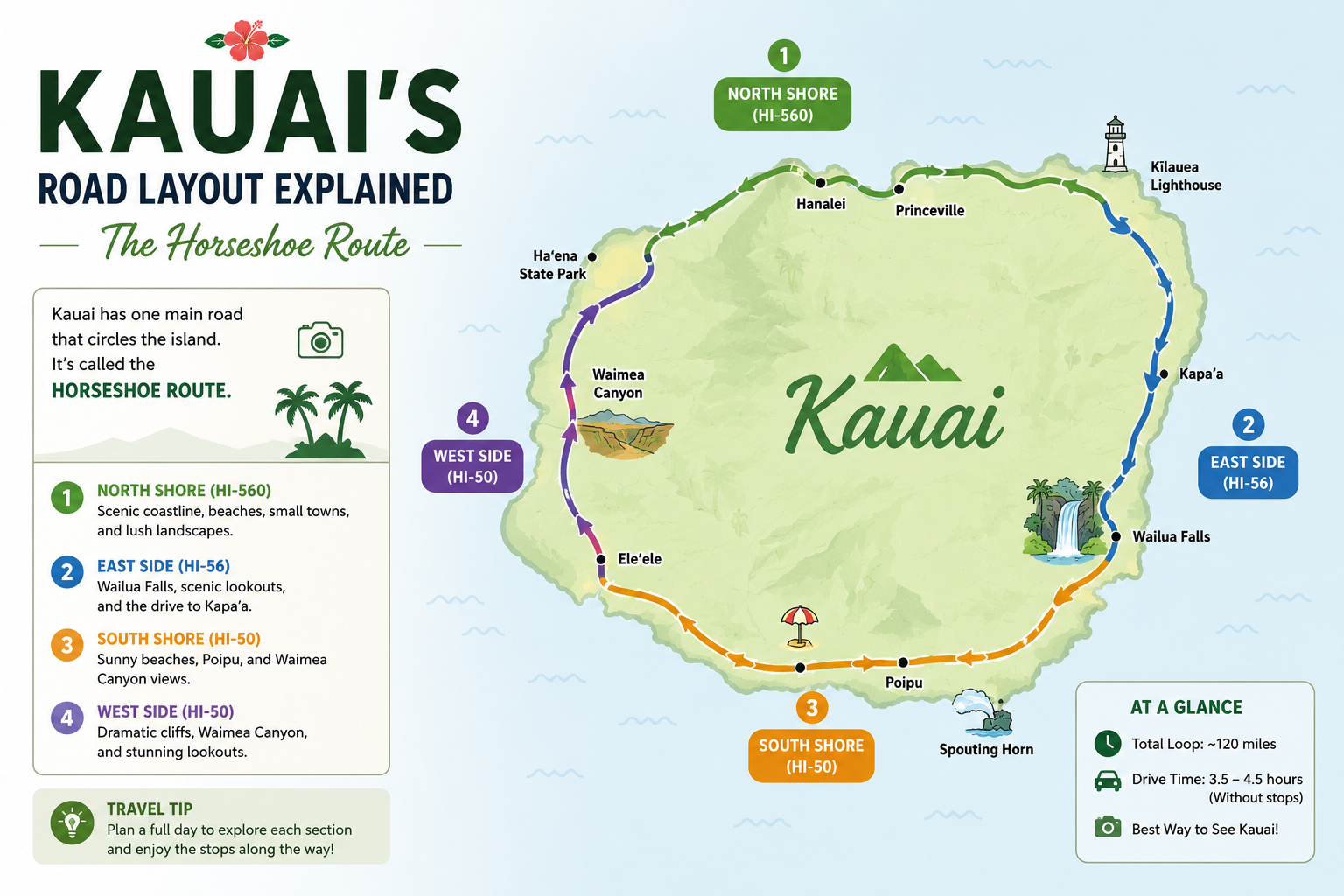
Understanding how Kauai’s roads work will save you hours of confusion:
Kauai is shaped like a slightly squashed circle, and the highway tries to wrap around it but gives up at both ends, defeated by the Na Pali cliffs in the northwest. What that means in practice: Kauai is not a circle you drive around — it is a horseshoe you drive into and back out of. Everything is measured from Lihue, the airport town in the middle of the east coast, because that is where the road splits: one branch curls north and west toward Hanalei, the other drops south and west toward Poipu and Waimea.
Think of it this way: you have two routes from Lihue. North takes you to Hanalei Bay and the end of the road at Ha’ena. South takes you to Poipu Beach, Waimea Canyon, and Polihale State Park. The Na Pali Coast sits between those two dead ends — and it has no road at all.
5. Top Things to Do in Kauai, Hawaii
Nā Pali Coast — Kauai’s Crown Jewel
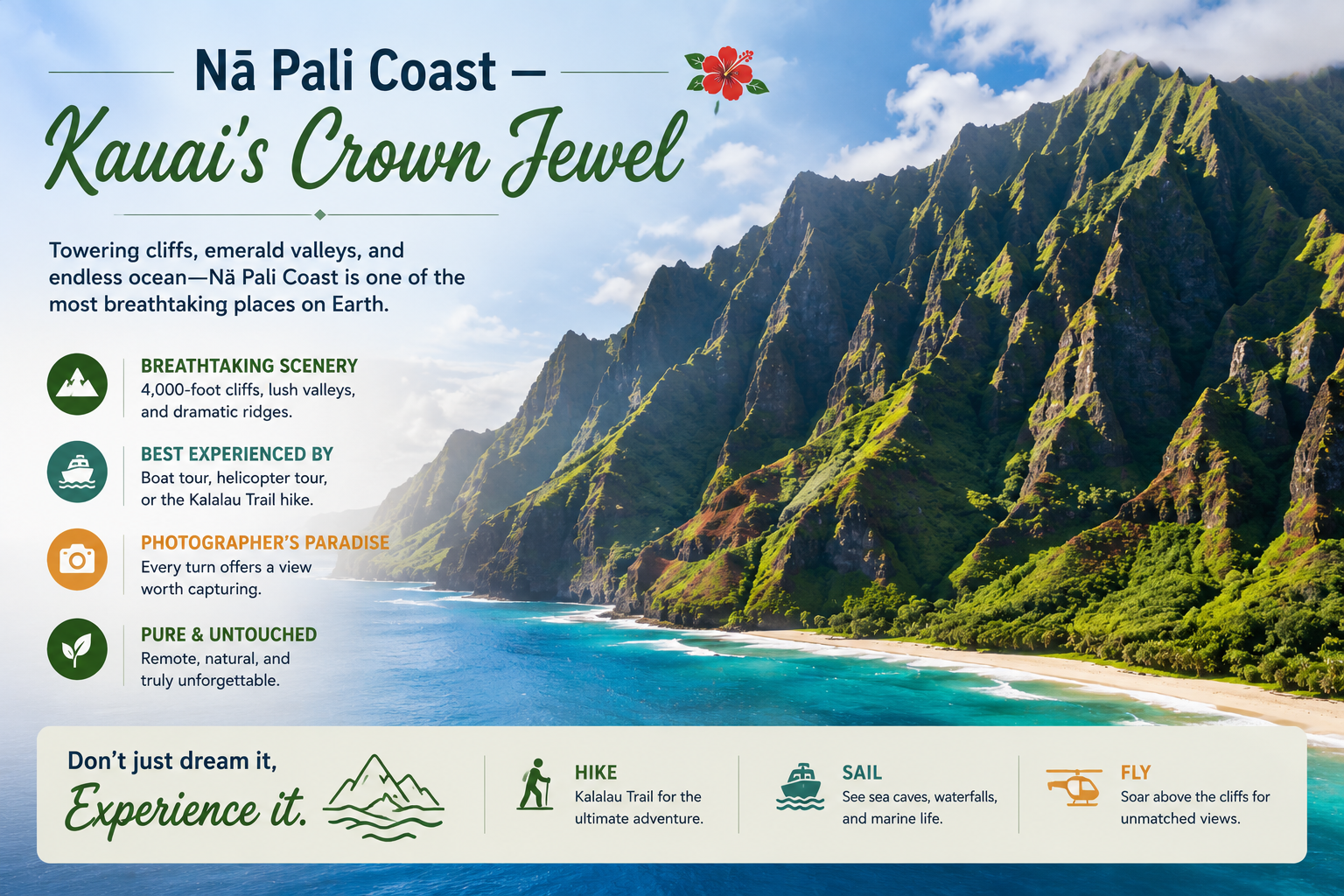
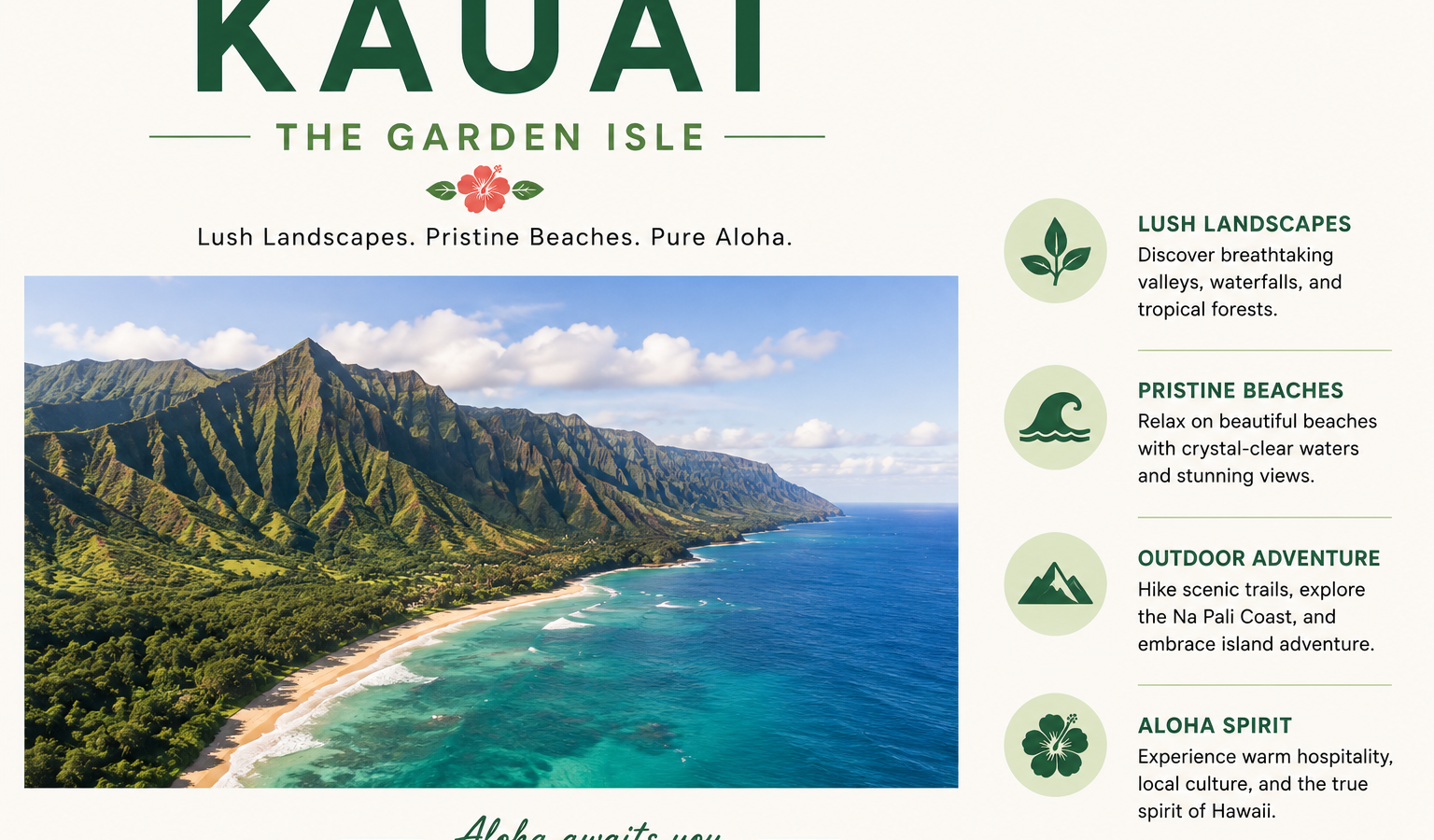
No experience in Hawaii compares to seeing the Nā Pali Coast for the first time. Stretching along the northwest side of the island, the Nā Pali Coast is a 17-mile stretch of soaring sea cliffs, emerald valleys, and hidden waterfalls. The cliffs reach elevations of more than 4,000 feet, making them among the tallest coastal formations in the world.
This region is accessible only by sea, air, or trail. Each turn along the coastline reveals a new perspective: sea caves sculpted by time, ancient Hawaiian fishing villages, and pristine beaches untouched by development.
Three ways to experience Nā Pali:
- Helicopter: The most comprehensive view — you see everything, including interior valleys inaccessible any other way.
- Boat Tour: Zodiacs and catamaran sunset cruises travel along the coast, with opportunities to snorkel sea caves and see the cliffs from water level.
- Kalalau Trail: The 11-mile cliffside hiking trail is one of the most dramatic hikes in the US — but requires permits and serious preparation. See the hikes section below.
Waimea Canyon — Grand Canyon of the Pacific
Waimea Canyon on the island of Kauai, Hawaii, is often called the Grand Canyon of the Pacific. At roughly 22 kilometers long, 1.6 kilometers wide, and over 900 meters deep, it is by far the largest canyon in the Pacific islands and one of the most colorful on Earth. Unlike most major canyons, which are carved through sedimentary rock, Waimea Canyon cuts through the basaltic lava flows that built Kauai over five million years ago. The combination of tropical rainfall, volcanic geology, and the island’s relative youth creates a landscape of vivid red-orange cliffs streaked with green vegetation and laced with waterfalls. The name “Waimea” translates to “reddish water” — a reference to the iron-rich soil that washes into the river after heavy rains, turning its water into a distinctive red hue.
Don’t miss: The Puu Hinahina Lookout offers views not only of the canyon but also of the forbidden island of Niihau to the west. Further up the road, the Kalalau Valley Overlook provides a stunning view down to the Na Pali Coast, connecting the canyon experience with Kauai’s famous coastal cliffs.
Wailua Falls & Wailua River
The Wailua River is Kauai’s most famous river — and the only navigable river in Hawaii. Wailua Falls, the double waterfall that tumbles approximately 80 feet into a jade-colored pool, is one of the island’s most photographed landmarks. You may recognize it as the opening scene of the classic TV show Fantasy Island.
Kayaking the Wailua River to reach the Fern Grotto — a natural lava rock amphitheater draped in ferns — is a classic Kauai experience ideal for families and first-time visitors.
Spouting Horn
On the south shore near Poipu, Spouting Horn is a natural lava rock blowhole where ocean waves are forced through an underground lava tube, shooting a geyser of water up to 50 feet into the air. The sound it makes — a deep, mournful moan — is as memorable as the sight. Free to visit, and worth the 15-minute detour.
Kauai Helicopter Tours
2 Soar over the dramatic Na Pali Coast. The only way to see the spectacular, surreal beauty of Kauai is via a helicopter: dipping low over razor-thin cliffs, fluttering past sparkling waterfalls, and swooping down into the canyons and valleys of the fabled Waimea Canyon.
A helicopter tour is the single most expensive thing you’ll do in Kauai — and almost universally considered the best money spent. The tour reveals Manawaiopuna Falls (better known as the “Jurassic Park waterfall”), interior valley systems completely invisible from any road, and the full scale of the Na Pali Coast that even the boat tours can’t fully capture.
Book in advance — popular time slots sell out weeks ahead.
Snorkeling, Diving & Water Adventures
Kauai also offers ATV tours & off-road rides, zipline adventures, hidden waterfall swims, mountain tubing, hiking tours, fishing charters, kayak tours, surfing lessons, stand-up paddling, and scuba diving.
For snorkeling, Tunnels Beach (Makua Beach) on the North Shore and Poipu Beach on the South Shore are the top picks — both offer clear water and rich marine life including sea turtles, monk seals, and colorful reef fish.
6. Best Beaches in Kauai, Hawaii
Kauai’s beaches are spectacular and, crucially, not all swimmable. The same wild ocean that makes them beautiful makes some of them dangerous. Pick by season and conditions, not by photo.
Hanalei Bay (North Shore)
On the North Shore, gentle waves roll across the golden sands of half-moon Hanalei Bay, where sheer volcanic ridges laced by waterfalls rise to 4,000 feet in the background, making it perfect for swimming, surfing, fishing, canoe paddling, and kayaking. A two-mile crescent of golden sand under green mountains, calm and shallow in summer, with the famous pier and a backdrop that looks fake. The postcard. Best for swimming in summer (May–September). Winter swells can make it unsuitable for casual swimmers.
Poipu Beach (South Shore)
On the south shore, big, wide Poipu Beach features a lava-rock jetty, protecting a sandy-bottomed pool that’s perfect for children on one side and an open bay attracting swimmers, snorkelers, and surfers on the other. The sunny, family-friendly all-rounder, with lifeguards, gentle water, and resident monk seals that occasionally nap on the sand. (Give them space — it’s the law, and it’s the right thing to do.) Best year-round beach for families and first-time visitors.
Ke’e Beach
Heading to this beach requires a lot of advanced planning in the form of a reservation, but it’s worth it. This is a favorite beach for summer swimming, thanks to the crystal clear water and the stunning cliffs as a backdrop.
Ke’e marks the beginning of the Kalalau Trail and the official end of the North Shore road. Permits are required through the Ha’ena State Park reservation system and must be booked well in advance.
Shipwreck Beach
The beaches along the south shore certainly radiate more vibrancy than others on Kauai. With a nice variety of beaches to select from — one personal favorite is Shipwreck Beach. It’s dramatic rather than swimmable for most visitors — powerful shorebreak and strong currents make it a better spot for watching bodyboarders and cliff-jumpers than casual swimming. Scenically, it’s one of the most beautiful spots on the island.
7. Best Hikes in Kauai, Hawaii
Kalalau Trail — Kauai’s Most Legendary Hike
The Kalalau Trail runs 11 miles along the Na Pali Coast from Ke’e Beach to Kalalau Valley. It is one of the most dramatic hiking trails anywhere in the United States. The start of the famous Kalalau trail departs from Ke’e Beach, but you’ll need a permit to access the hiking trail.
The first 2 miles to Hanakapiai Beach are the most accessible and require only a day use permit. The full 11-mile trail to Kalalau Valley requires an overnight camping permit and is a serious multi-day backcountry experience. Book permits months in advance through the DLNR Hawaii reservation system.
Difficulty: Strenuous — not suitable for beginners. Wet conditions and steep cliffs demand proper footwear and preparation.
Waimea Canyon Trail System
For a real hike, the Waipoo Falls trail drops into the canyon to a waterfall and a pool — a few hours, genuinely rewarding, and far quieter than the roadside crowds.
The Waimea Canyon complex offers trails for all fitness levels — from the short, flat Canyon Trail lookout walks to the more demanding Awaawapuhi Trail (6.4 miles round-trip), which ends at a knife-edge ridge with views down both sides to the Na Pali valleys below.
Sleeping Giant Trail (Nounou Mountain)
One of Kauai’s most popular and accessible hikes. The ridge-top trail rises above the east shore with panoramic views from Hanalei Bay in the north to Poipu in the south on a clear day. The 3.5-mile round trip gains about 1,000 feet in elevation — manageable for most moderately fit hikers.
8. Where to Stay in Kauai, Hawaii
South Shore — Poipu (Best for First-Timers)
The South Side — Poʻipū, Koloa, Lawai — is the driest, sunniest part of Kauaʻi and where most first-time visitors end up booking. Poʻipū is the resort hub: a compact cluster of beachfront hotels, condos, and vacation rentals with Poʻipū Beach Park at its center. You’re close to Waimea Canyon (about 45 minutes west), Spouting Horn, a good concentration of restaurants, and the old sugar town of Koloa a few minutes inland.
Best for: Families, first-time visitors, guaranteed sunshine, beach access, and resort amenities.
Top properties: Grand Hyatt Kauai Resort & Spa, Koloa Landing Resort, Sheraton Kauai Coconut Beach Resort.
North Shore — Hanalei & Princeville
This is the most dramatically beautiful place to stay on the island — and the most weather-dependent. 18The north shore (Hanalei, Princeville) is green, dramatic, and genuinely rainy. In summer, it offers some of the best weather on the island. In winter, extended rain and large surf are common.
Best for: Couples, experienced Hawaii travelers, photography enthusiasts, surfers, and those who prioritize scenery over sunshine guarantees.
Top properties: 1 Hotel Hanalei Bay (the Princeville resort, newly transformed), Hanalei Colony Resort.
East Shore — Kapaa
The middle ground between north and south. Kapaa offers a more local, down-to-earth feel than the resort zones — lined with local restaurants, small shops, and a beachfront bike path. It’s convenient to both north and south-shore destinations and generally more affordable.
Best for: Independent travelers, those on a mid-range budget, and repeat visitors who’ve already done the resorts.
Hotels vs. Vacation Rentals — Which to Choose?
Go for a hotel if you’re looking for the traditional resort experience with big pools, nearby beaches, and restaurants within walking distance. Opt for a vacation rental if you want access to a kitchen, are looking for space, or are looking to save money.
A hybrid strategy works well: book a vacation rental for the majority of your stay so you have access to a kitchen and a little more space. Then treat yourself to a great resort for a few days to enjoy the pool and other amenities. This has been a winning combo.
9. Where to Eat in Kauai, Hawaii
Kauai’s food scene punches well above its weight for a small island. Here are the categories and key stops to know:
Local Hawaiian Plates
- The Shrimp Station (Waimea): Famous garlic shrimp plates, roadside casual, and the perfect fuel stop before or after a Waimea Canyon day.
- Pono Market (Kapaa): A local institution. The poke bowls are exceptional and the plate lunches are the real deal.
North Shore Dining
- Hanalei Taro & Juice Co.: Taro-based local dishes and fresh juices right in the heart of Hanalei town.
- Postcards Café: One of the most acclaimed farm-to-table restaurants on the island — worth the reservation.
South Shore Dining (Poipu)
- Merriman’s Fish House: Celebrated chef Peter Merriman’s oceanfront restaurant. One of the top dining experiences on the island.
- Keoki’s Paradise (Koloa): A reliable, lively spot for seafood in a tropical garden setting.
Food Trucks & Casual
Kauai has a thriving food truck culture, especially in Kapaa and at the Koloa Farm Market. Look for the Wednesday Sunshine Markets for the freshest local produce.
10. Kauai Hawaii Travel Tips & Practical Information
Permits & Reservations Required
Do not arrive without these booked in advance:
| Permit/Reservation | What It Covers | Where to Book |
|---|---|---|
| Ha’ena State Park Pass | Access to Ke’e Beach & Kalalau trailhead | gostateparks.hawaii.gov |
| Kalalau Trail Permit | Day use (first 2 miles) and overnight camping | gostateparks.hawaii.gov |
| Helicopter Tour Booking | Tours fill weeks ahead | Direct with operators |
| Na Pali Boat Tours | Limited permits for Na Pali operations | Direct with operators |
Budget & Average Daily Costs (2026)
| Category | Budget | Mid-Range | Luxury |
|---|---|---|---|
| Accommodation | $100–$175/night | $175–$350/night | $400+/night |
| Rental Car | $65–$100/day | $100–$150/day | $150+/day |
| Meals | $30–$50/day | $60–$100/day | $150+/day |
| Activities | $50–$100/day | $150–$300/day | $300+/day |
| Daily Total | ~$250/day | ~$500/day | $1,000+/day |
Helicopter tours average $250–$350 per person and are typically a one-time trip expense.
What to Pack for Kauai
- ☑️ Reef-safe sunscreen (required by law in Hawaii)
- ☑️ Waterproof hiking sandals or trail shoes
- ☑️ Rain jacket (even in summer — brief showers are common)
- ☑️ Dry bag for boat tours and beach days
- ☑️ Reef water shoes for lava shoreline
- ☑️ Reusable water bottle
- ☑️ Insect repellent for jungle hikes
- ☑️ Camera or GoPro with extra batteries
- ☑️ Layers for helicopter tours (cold at altitude)
11. Kauai vs. Other Hawaiian Islands — Which Is Right for You?
| Kauai | Maui | Oahu | Big Island | |
|---|---|---|---|---|
| Best For | Nature & seclusion | Resorts & beaches | Urban + history | Volcanoes & diversity |
| Beaches | Dramatic, varied | World-class | Waikiki + hidden gems | Black & green sand |
| Nightlife | Very limited | Moderate | Vibrant | Limited |
| Hiking | ⭐⭐⭐⭐⭐ | ⭐⭐⭐⭐ | ⭐⭐⭐ | ⭐⭐⭐⭐⭐ |
| Crowds | Low–Moderate | High | Very High | Low–Moderate |
| Price | Mid-High | High | Mid-High | Mid |
| Road Access | Limited (horseshoe) | Full circuit | Full circuit | Partial |
| Family Friendly | Very | Very | Very | Very |
Known as the Garden Isle, Kauai is the oldest and lushest Hawaiian island, with dramatic cliffs along the Nā Pali Coast, vibrant green valleys, and beaches that feel far less crowded than Maui or Oahu. It’s the perfect island if you’re looking for nature, scenery, and a laid-back vibe.
12. Frequently Asked Questions About Kauai, Hawaii
Q1: What is Kauai, Hawaii known for? A: Kauai is best known for the Nā Pali Coast’s soaring sea cliffs, Waimea Canyon (the Grand Canyon of the Pacific), Hanalei Bay, and its extraordinary natural beauty. It is the oldest and most lush of the main Hawaiian Islands, covered in rainforests and waterfalls that earned it the nickname “The Garden Isle.”
Q2: What is the best time to visit Kauai, Hawaii? A: April through June and September through October represent the best all-around windows. These shoulder months combine reliably good weather, excellent conditions for outdoor activities, lighter crowds than summer or the holidays, and better rates on accommodations and flights.
Q3: Do I need a rental car in Kauai? A: Yes — it is essential. There is no meaningful public transportation, and the island’s attractions are spread along its one main road. Book your car as early as possible.
Q4: Which airport serves Kauai, Hawaii? A: Lihue Airport (LIH) is the only commercial airport on the island, located on the east coast. Direct mainland flights operate from Los Angeles, San Francisco, Seattle, and other West Coast cities.
Q5: How many days should I spend in Kauai? A: Four to six days is enough to cover the Na Pali Coast, Waimea Canyon, and a few beach and waterfall days. We recommend at least 5 nights to avoid feeling rushed.
Q6: Is Kauai good for families with kids? A: Absolutely. Poipu Beach has lifeguards and calm water. The Wailua River kayak and Fern Grotto experience is perfect for all ages. The Waimea Canyon drive is manageable for any fitness level. And the helicopter tour is an experience children never forget.
Q7: Is Kauai better than Maui? A: Neither is objectively “better” — they serve different travelers. Kauai wins on raw natural beauty, seclusion, and outdoor adventure. Maui offers more resort options, nightlife, and dining diversity. For first-time Hawaii visitors who want beaches and resort comfort, Maui or Oahu may be easier starting points. For those who prioritize nature, hiking, and escaping the crowds, Kauai is unrivaled.
Q8: What permits do I need for Kauai? A: You need an online reservation/permit to access Ha’ena State Park (Ke’e Beach) and the Kalalau Trail. These must be booked in advance through the state parks reservation system. Popular dates — especially summer weekends — sell out months ahead.
13. Final Thoughts — Is Kauai, Hawaii Worth Visiting?
Nature is king in Kauai. Hawaii’s most underrated island is a veritable oasis of lush rainforests. But “underrated” doesn’t mean undiscovered — it means Kauai refuses to be overdeveloped. That refusal is a policy, a cultural choice, and ultimately the thing that makes the island what it is.
There is no skyscraper on this island. No major nightclub strip. No franchise-heavy tourist boardwalk. What there is, in extraordinary abundance, is landscape. Landscape that took five million years to build and that remains — remarkably — largely intact.
If your ideal vacation involves watching a monk seal sleep on the beach while a waterfall tumbles down a cliff face behind you, Kauai is your island.
If it involves a helicopter ride over sea cliffs that make you genuinely wonder whether you’re still on planet Earth, Kauai is your island.
If you want to understand why Hawaii is considered one of the most beautiful places on Earth — not as a marketing claim but as a factual statement — then Kauai is your island.
Plan carefully, book your permits and car early, and give yourself at least a week. The Garden Isle rewards those who come prepared — and forgives those who fall in love with it and never quite want to leave.