Introduction
Most people fly over Molokaʻi on their way to Maui and never look down. That’s exactly how the island prefers it.
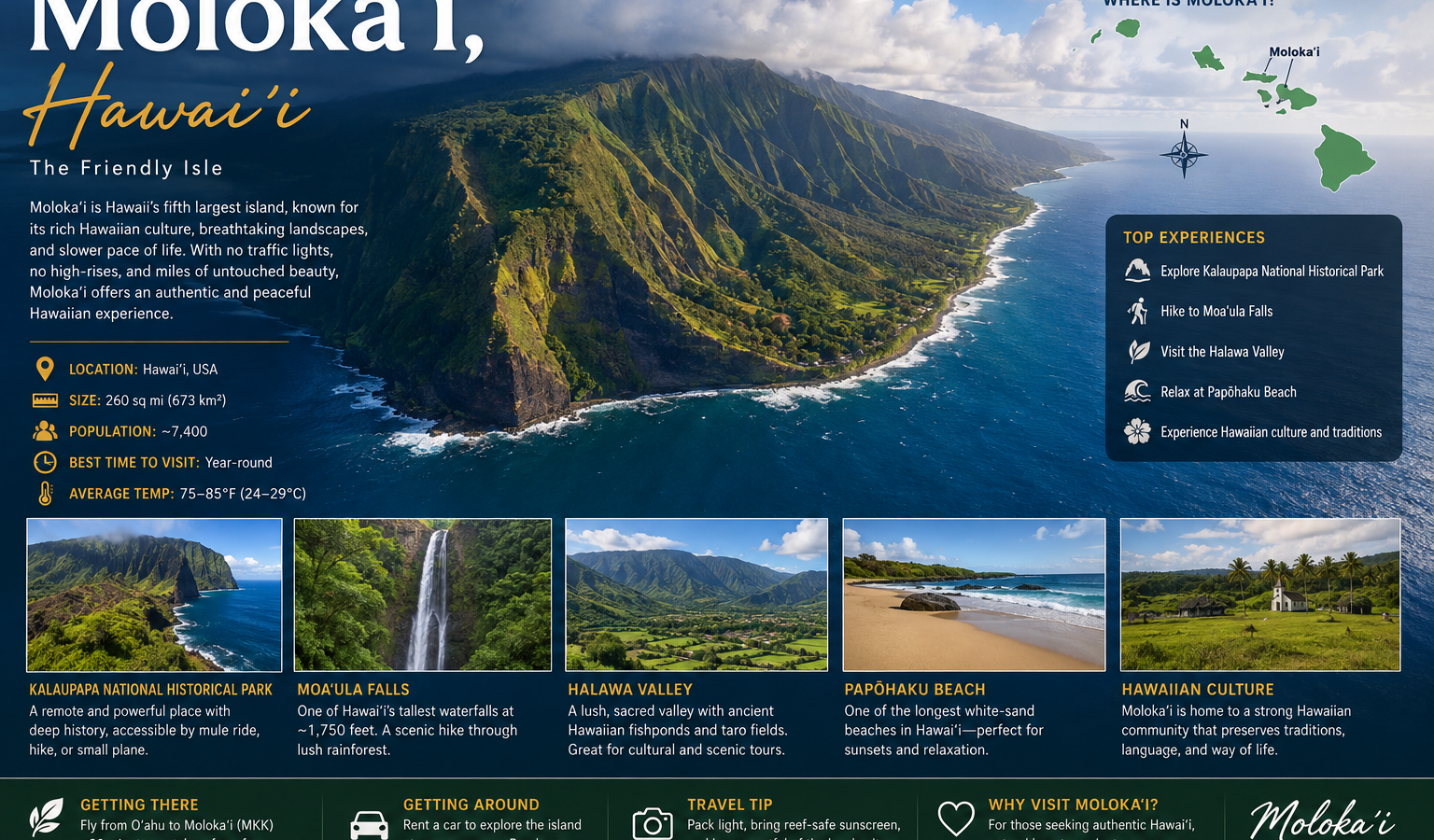
Molokaʻi is not trying to compete with Maui’s luxury resorts or Oʻahu’s buzzing Waikīkī strip. It never has. 1It has no deluxe resorts, no stoplights, and no buildings taller than a coconut tree — and it is the least developed of all the Hawaiian islands, making it especially attractive to adventure travelers and peace seekers.
That’s the point.
If you are the kind of traveler who gets frustrated by crowds, overly manicured tourist experiences, and Instagram-first destinations — Molokaʻi may be the most rewarding few days you will ever spend in Hawaiʻi. But it is not for everyone. And it is not a destination that tolerates being treated like a theme park.
This guide gives you everything you need to visit Molokaʻi the right way in 2026: current access updates, honest expectations, the best things to see and do, and how to respect a community that has deliberately chosen to live differently from every other island in the chain.
What Is Molokaʻi? Understanding the “Friendly Isle”
Quick Facts About Molokaʻi
Molokaʻi, the fifth-largest island in Hawaii, stretches 38 miles from end to end and spans 10 miles at its widest point. It is part of the Hawaiian archipelago, located in the central Pacific Ocean, with a land area of approximately 260 square miles (670 square kilometers). Molokaʻi is located about 25 miles to the east of Oʻahu across the Kaiwi Channel and just 8 miles northwest of Maui.
| Quick Fact | Detail |
|---|---|
| Nickname | The Friendly Isle |
| Population | ~7,000 residents |
| Main Town | Kaunakakai |
| Area | ~260 square miles |
| Airport | Molokaʻi Airport (MKK), Hoʻolehua |
| Highest Point | Kamakou, 4,961 ft |
| Known For | Kalaupapa, hula birthplace, sea cliffs, untouched beaches |
On the red-dirt southern plain, where most of the island’s 7,000 residents live, the rustic village of Kaunakakai looks like the set of an old Hollywood Western, with sun-faded clapboard houses and horses tethered on the side of the road. Molokaʻi lives up to its reputation as the most Hawaiian place chiefly through its lineage — there are more people here of Hawaiian blood than anywhere else. This slipper-shaped island is the birthplace of hula and the ancient science of aquaculture.
A Note on Visiting Respectfully
Before we go any further, this is important.
Molokaʻi is a home before it is a destination. A worthwhile visit begins with realistic expectations: follow current access rules, enter private or culturally sensitive places only with permission, support businesses and programs that explicitly welcome visitors, and do not go looking for “hidden” places that residents have chosen not to promote. 2 Its rural communities, cultural landscapes, sea cliffs, and extensive fringing reef are not products to consume. Molokaʻi’s community has repeatedly asked that tourism remain small, respectful, and shaped by local priorities.
This guide honors that request. Every recommendation here is visitor-appropriate and community-supported.
The History & Culture of Molokaʻi
Birthplace of Hula
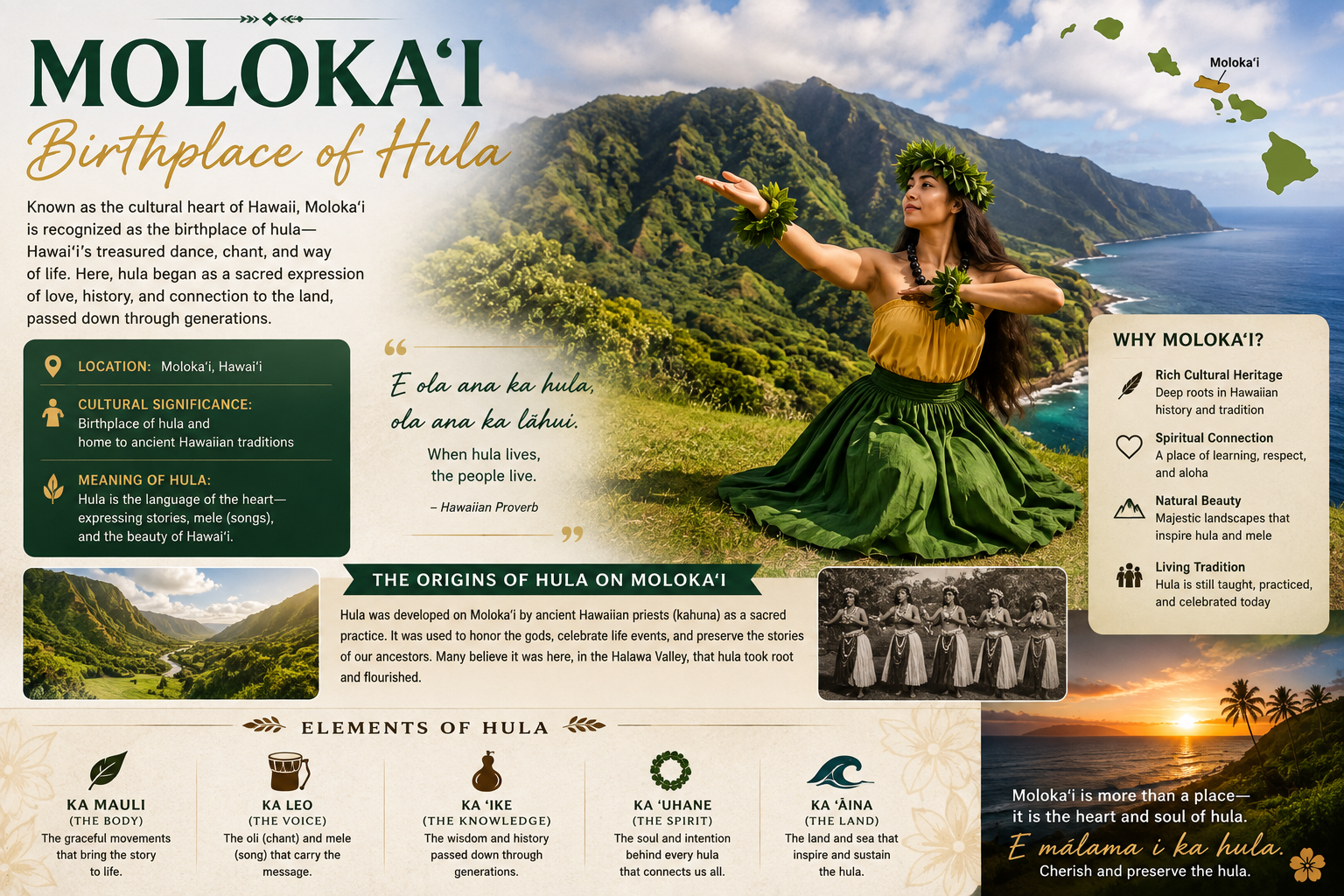
This island is the birthplace of hula and the ancient science of aquaculture. An aura of ancient mysticism clings to the land here, and the old ways still govern life.
According to Hawaiian tradition, the goddess Laka first danced the hula on the sacred hill of Puʻu Nānā on Molokaʻi’s north shore. This is not mythological trivia — it is a living cultural identity that shapes how residents relate to the land and how visitors are expected to behave upon it.
Kalaupapa — A Place of Profound History
One of the most significant places in all of Hawaiʻi sits on Molokaʻi’s Kalaupapa Peninsula — a former settlement for people with Hansen’s disease (leprosy), where individuals were forcibly exiled beginning in 1866. 8Kalaupapa National Historical Park is known for its stunning cliffs and panoramic views, but its significance goes far beyond scenery. It is a place of immense human suffering, resilience, and — through the work of Father Damien and others — profound compassion.
2026 Access Update — Read Before You Plan:
As of August 2026, access to Kalaupapa National Historical Park is in flux. Kalaupapa Saints Tours ended in June 2026 after the passing of its founder, longtime resident Aunty Meli Watanuki. The National Park Service provided its first public tour on July 9, 2026, but on July 11, 2026, said protesters were present and that future public tours are temporarily paused while it reassesses the feasibility of visitor access. Do not count on Kalaupapa tour access when planning a Molokaʻi trip until the NPS guided tours page posts a new update.
Native Hawaiian Heritage
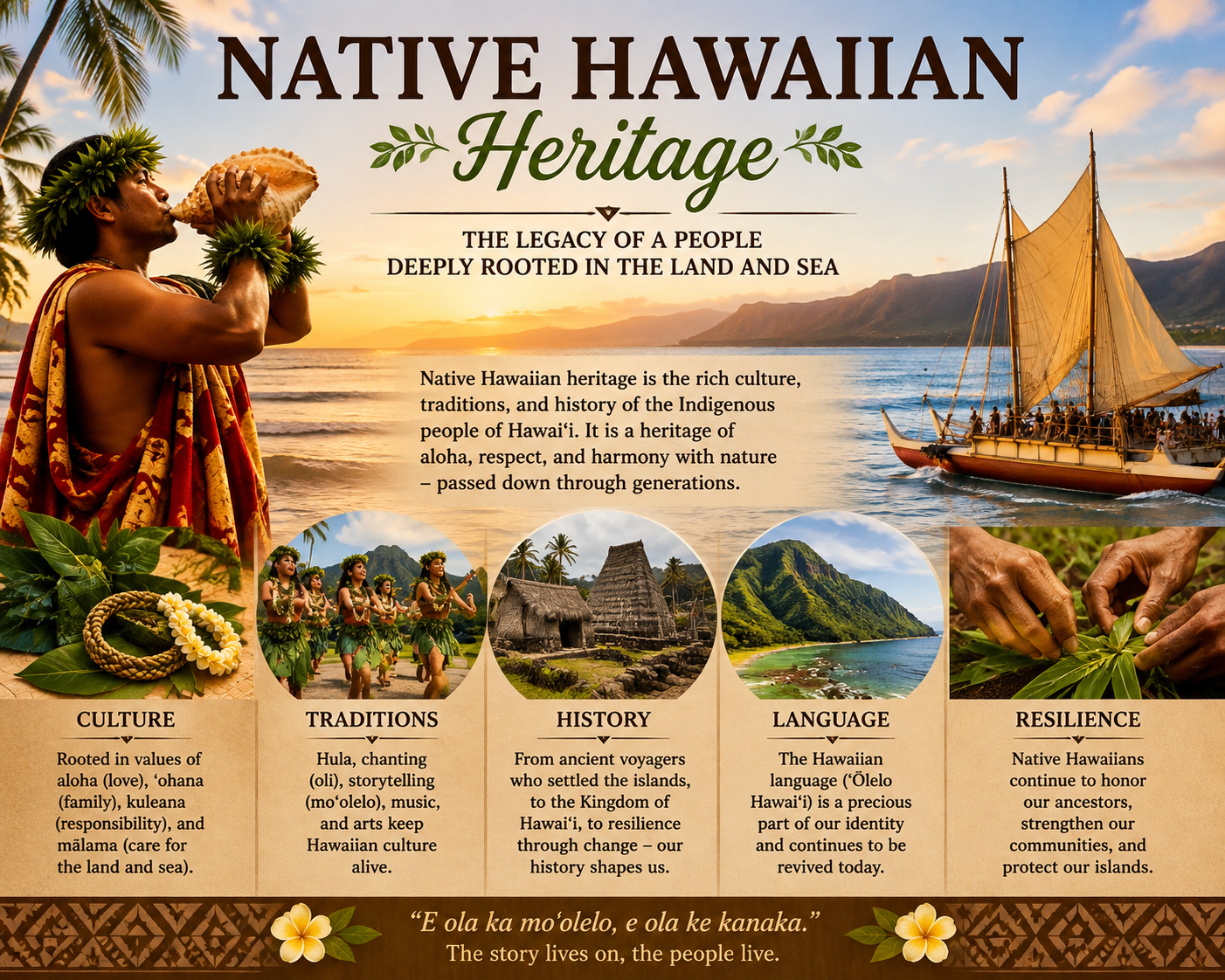
Locals have intentionally resisted mass tourism to preserve their traditional Hawaiian way of life. The residents survive by fishing and hunting wild pigs and axis deer on the range. Some folks still catch fish for dinner by throwing nets and trolling the reef. These are not tourist performances. This is daily life, and it deserves your respect.
How to Get to Molokaʻi in 2026
Flying to Molokaʻi (MKK Airport)
Flying is the only reliable way to reach Molokaʻi. There are no direct flights from the mainland U.S. to Molokaʻi. Travelers must connect through Honolulu or Maui.
You can book flights through Hawaiian Airlines, which has direct flights from Honolulu in Oʻahu and Kahului in Maui. You can also book a flight through Mokulele Airlines, which offers flights from Kahului, Kapalua, and Hana in Maui, as well as Kona and Waimea on the Big Island. The flights are incredibly short — only around 25 minutes or so. And you won’t be on a Boeing 737. Instead, you’ll most likely be flying on turboprop planes that only carry around 50 passengers.
Booking Tips:
- Aim to book flights 6 to 8 weeks out, longer for school holidays or big island festivals, when tiny Molokaʻi fills fast. Morning flights are smoother and less delayed, so you’re not landing in the dark
- We recommend against planning a tight connection between your mainland and Molokaʻi flights. Give yourself a buffer night on Maui or Oʻahu.
Is There a Ferry to Molokaʻi?
This is one of the most Googled questions about the island — and the answer is no.
Despite some older posts on the internet mentioning the Molokaʻi Princess ferry, there is no ferry to Molokaʻi anymore. The ferry took passengers from Molokaʻi to Lahaina Harbor in Maui, but operations ceased in 2016. There is currently no public ferry between Honolulu and Molokaʻi; previous services stopped due to rough seas, costs, politics, and environmental concerns. Flying is your only practical option.
Getting Around Once You Arrive
There is no public transportation on Molokaʻi. A rental car is essential. Not every road is paved, so you may want to opt for an SUV if you plan on more adventurous excursions. There are no traffic lights, and speed limits are almost always under 45 mph and, in some cases, as low as 10 mph. There are no four-lane mega-highways either, just two-lane roads. Book accommodations and car rentals well in advance — availability is limited.
Best Things to Do on Molokaʻi
Molokaʻi is best for travelers who want quiet beaches, local Hawaiian culture, scenic drives, and a slower pace. Here are the experiences that make it worth the journey.
1. Kalaupapa National Historical Park (2026 Access Update)
As noted above, access is currently paused pending NPS review. However, viewing the peninsula from the cliffs above remains possible and profoundly moving. The Kalaupapa Overlook offers a sweeping view of the entire settlement from the rim of the sea cliffs — no tour required.
2. Halawa Valley & Waterfalls
Halawa Valley is a lush valley with hiking trails that lead to stunning waterfalls and ancient Hawaiian cultural sites. This is one of the oldest inhabited areas in Hawaiʻi, and guided hikes with local families are the respectful — and required — way to visit. Do not hike this trail independently. Book a guide in advance.
3. Pāpōhaku Beach
Pāpōhaku Beach is a beautiful, 2.0-mile (3.2 km) long beach on the West Side of Molokaʻi that is renowned by both locals and visitors as one of the best places on the island to catch the sunset year-round. It is one of the largest white sand beaches in all of Hawaiʻi, and on most days, you may be the only person on it.
4. Kamakou Preserve
Kamakou Preserve is a nature preserve with diverse plant and animal species, including rare native birds. Located in the island’s misty highlands, this is the closest thing to primeval Hawaiʻi you will find anywhere. Access requires planning — the road is rough and four-wheel drive is recommended.
5. Molokaʻi Plumeria Farm
The smell reaches you long before the sea of yellow and white blooms comes into view at Molokaʻi’s Plumeria Farm. You’ll find plenty of things to do, including strolling the 10-acre farm a few miles from Kaunakakai. Make sure to pick flowers to make your very own lei afterward. You can also take a guided workshop to sew your lei or buy one to take with you. Plumeria are in bloom from March through October. If you’re visiting during winter months, the farm may have limited flower-picking activities.
6. Snorkeling at Molokaʻi’s Coral Reefs
Snorkel Molokaʻi’s coral reefs to discover vibrant marine life in the clear waters. The island hosts the longest fringing reef in the United States. Along the coastal highway, a fringing coral reef is visible through the crystal-clear waves. Murphy Beach and Dixie Maru Beach on the West Side are the two most snorkeler-friendly spots.
7. Pēpēʻōpae Bog Trail
The Pēpēʻōpae Bog Trail is a remote, high-elevation trail in the mountains above Kaunakakai that is, by some accounts, the reason you come to Molokaʻi. This ethereal boardwalk trail leads through one of the last intact native bogs in Hawaiʻi, with carnivorous plants, rare mosses, and panoramic mist-draped views. Book this far in advance — access is through the Kamakou Preserve and extremely limited.
Best Beaches on Molokaʻi
Pāpōhaku Beach
The crown jewel. Miles of white sand, practically zero people. Strong currents make swimming dangerous, but for a sunset walk, a picnic, or just sitting in silence watching the ocean, nothing on the island compares.
Murphy Beach (Waialua)
Murphy Beach (aka Waialua) is great for kids, as it is shallow, probably maximum 3ft out 100 ft and protected especially inside the old rock wall rubble. This is also one of the better snorkeling spots on the East Side.
Dixie Maru Beach
One of two beaches in Molokaʻi that are “beach snorkelable,” with the other being Murphy Beach on the East Side. Located on the far southwest side, it’s calm, clear, and excellent for families.
Make Horse Beach (Pōhakumāuliuli)
Make Horse Beach is one of the favorite West Molokaʻi beaches, as few people tend to visit compared to the much more popular Kepuhi Beach down the road. If you want true solitude, this is your spot.
Where to Stay on Molokaʻi
Hotel Molokaʻi — The Only Hotel on the Island
Hotel Molokaʻi remains the primary hotel on the island. It is a low-key, charming oceanfront property in Kaunakakai with an open-air restaurant, thatched-roof bungalows, and a pool. It is not luxurious — and that is entirely the point.
Condo Rentals & Vacation Homes
There are no traffic lights or beachside cottages, and visitors can relax at a single hotel or one of five condo complexes. Vacation rentals through VRBO or Airbnb exist, but verify that any listing has a valid Hawaii Transient Vacation Rental permit. Choose legally operating properties — illegal short-term rentals take housing away from residents.
Booking Tips
- One main town, limited rooms, and scarce rental cars reward travelers who sort out costs, weather, and the day-by-day plan in advance.
- Book 3–6 months ahead for peak season (December–March, June–August).
- Manage expectations: rooms are clean and comfortable, not resort-level.
Where to Eat on Molokaʻi
Molokaʻi is not a food destination in the culinary tourism sense — and that’s perfectly fine. Here is what you will find.
Must-Try Local Spots
- Kanemitsu Bakery — Famous for Molokaʻi bread. Locals line up for it. You should too.
- Molokaʻi Drive-Inn — Classic plate lunch, local comfort food. Cash-friendly, no frills.
- Hotel Molokaʻi Restaurant — The most reliable sit-down dining on the island.
Molokaʻi Burger
While there aren’t many restaurants on Molokaʻi, Molokaʻi Burger is the best go-to place for classic American burgers, huge waffle fries, and ice cream. It is also worth mentioning that Molokaʻi Burger is open later than most restaurants in town.
Tips:
- Bring cash — some local spots do not take cards.
- Grocery supplies are limited; stock up when you arrive.
- Respect business hours — many places close early.
Best Time to Visit Molokaʻi
Weather by Season
Year-round temperatures average around 75°F (23.9°C). The West End is generally more arid. The mountainous East End is wetter and greener.
| Season | Months | Weather | Crowds | Notes |
|---|---|---|---|---|
| Peak | Dec–Mar, Jun–Aug | Warm, occasional rain | Higher | Book way ahead |
| Shoulder | Apr, Nov, early Dec | Mixed | Low | Best value |
| Summer | Jun–Aug | Hot, dry West Side | Moderate | Good for beaches |
| Winter | Dec–Feb | Cooler, wetter | Moderate | Whale watching offshore |
Shoulder Season Advantage
The shoulder season, which includes April, November, and early December, can also be relatively affordable for a trip to Molokaʻi. During these months, you might encounter a mix of weather patterns, but you’ll also avoid the high prices and crowds that come with peak season.
Molokaʻi Travel Budget & Costs
Molokaʻi is paradoxically one of Hawaii’s more expensive islands to visit — not because it’s luxurious, but because of limited supply and higher shipping costs for goods.
| Expense | Estimated Cost |
|---|---|
| Inter-island flight | $80–$200 round trip |
| Hotel Molokaʻi (per night) | $180–$260 |
| Car rental (per day) | $80–$130 |
| Meals (per day) | $40–$80 |
| Activities | $0–$150 (most are free or low-cost) |
| Typical 3-day budget (1 person) | $700–$1,200 total |
Money-Saving Tips:
- Cook some meals using groceries from the Friendly Market in Kaunakakai
- Most beaches, drives, and trails are free
- Book flights and car rentals 6–8 weeks ahead for best rates
- Avoid unnecessary day tours — the best of Molokaʻi is self-guided
Molokaʻi vs. Other Hawaiian Islands
Maui vs. Molokaʻi
| Factor | Molokaʻi | Maui |
|---|---|---|
| Tourism Level | Minimal | Very High |
| Beaches | Uncrowded, raw | Polished, popular |
| Resorts | None | Dozens |
| Activities | Nature, culture | Everything |
| Cost | High (limited supply) | High (demand) |
| Authenticity | Very High | Moderate |
Molokaʻi vs. Oʻahu
| Factor | Molokaʻi | Oʻahu |
|---|---|---|
| Nightlife | None | Vibrant |
| Shopping | Minimal | Extensive |
| Traffic | Zero | Heavy |
| Culture | Deep | Diverse but diluted |
| Beaches | Empty | Busy |
Is Molokaʻi Worth Visiting?
Many travelers wonder whether a day trip to Molokaʻi is worth it. The answer is yes for visitors seeking local experiences, scenic drives, and uncrowded natural beauty. Molokaʻi is not the best Hawaiian island for every traveler. If you want luxury resorts, shopping malls, nightlife, and packed activity schedules, you may enjoy Oʻahu or Maui more. Many first-time Hawaii visitors book Molokaʻi expecting Maui-style tourism. The experience is completely different. Molokaʻi feels more rural, less commercial, and far more local.
Practical Travel Tips for Molokaʻi
✅ Book everything early. Flights, cars, and accommodations fill up fast on a small island.
✅ Bring cash. Many local businesses prefer or require it.
✅ Get a car. There is no public transportation on Molokaʻi. You will need a rental to see anything beyond Kaunakakai.
✅ Slow down. Molokaʻi deliberately moves at a much slower pace. Fighting that pace will ruin your trip.
✅ Ask permission. Molokaʻi is home to many culturally significant locations. Always ask for permission before entering these areas and be mindful of local customs, as they are deeply tied to the community’s identity.
✅ Support local businesses. Choose to shop at local markets and eat at family-owned restaurants. This not only helps the economy but also fosters a sense of community and connection with the island’s heritage.
✅ Check Kalaupapa access before you go. As of July 2026, future public NPS tours are temporarily paused while the Park Service reassesses the feasibility of visitor access.
✅ Pack light. Small aircraft have strict baggage limits and fees. Carry-on only when possible.
✅ Don’t look for “hidden gems.” Do not go looking for “hidden” places that residents have chosen not to promote.
Is Molokaʻi Right for You? (Honest Assessment)
Go to Molokaʻi if you are:
- Seeking a genuinely authentic, non-commercial Hawaiian experience
- Comfortable with limited dining, shopping, and entertainment options
- Interested in Hawaiian culture, history, and nature on a deep level
- Looking for near-empty beaches and genuine solitude
- Traveling slowly — ideally 3–5 nights minimum
- Respectful of local community wishes
Skip Molokaʻi if you are:
- Expecting resort-level amenities or nightlife
- Planning a short trip and want maximum checked-off attractions
- Not comfortable with the remoteness or limited infrastructure
- Looking for a “day trip” experience — one day is not enough to do it justice
Molokaʻi is a great option for half of a trip in Hawaiʻi, while spending the other half on a different island, like Oʻahu or Maui, as this is where flights depart to get to Kaunakakai. By splitting your trip up this way, you could see many of the popular things to do on either island while saving activities like going to the beach and hiking for your time on Molokaʻi, where it is significantly less crowded.
FAQ
Q1. Where is Molokaʻi located?
Molokaʻi is part of the Hawaiian archipelago, located in the central Pacific Ocean, about 25 miles to the east of Oʻahu across the Kaiwi Channel and just 8 miles northwest of Maui.
Q2. How do I get to Molokaʻi?
There are flights to Molokaʻi Airport in Hoʻolehua. You can book flights through Hawaiian Airlines, which has direct flights from Honolulu in Oʻahu and Kahului in Maui. There is no longer a ferry to Molokaʻi.
Q3. Is there a ferry to Molokaʻi in 2026?
There is currently no public ferry between Honolulu and Molokaʻi; previous services stopped due to rough seas, costs, politics, and environmental concerns.
Q4. How long should I spend on Molokaʻi? At minimum, 2–3 nights. Ideally 4–5 nights to truly slow down, explore the East and West ends, and do a guided Halawa Valley hike. A day trip from Maui is possible but barely scratches the surface.
Q5. Is Kalaupapa open to visitors in 2026?
As of July 2026, future NPS public tours are temporarily paused while the Park Service reassesses the feasibility of visitor access. Do not count on Kalaupapa tour access when planning a Molokaʻi trip until the NPS guided tours page posts a new update.
Q6. Is Molokaʻi safe to visit? Yes — Molokaʻi is a safe destination. The key is being respectful of community boundaries and not wandering onto private or culturally sacred land. Visitors who come with the right attitude are welcomed warmly.
Final Thoughts
Molokaʻi is one of the last places on Earth — not just in Hawaiʻi — where you can stand on a two-mile beach and be completely alone. Where residents still fish for dinner with throw nets. Where the tallest structure in town is a coconut tree.
This is a place to stay if you are looking for a quiet, relaxing vacation in “old Hawaiʻi.” But more than a vacation — it is a chance to understand what Hawaiʻi was before the resorts arrived, and what it can still be when a community has the courage to protect itself.